
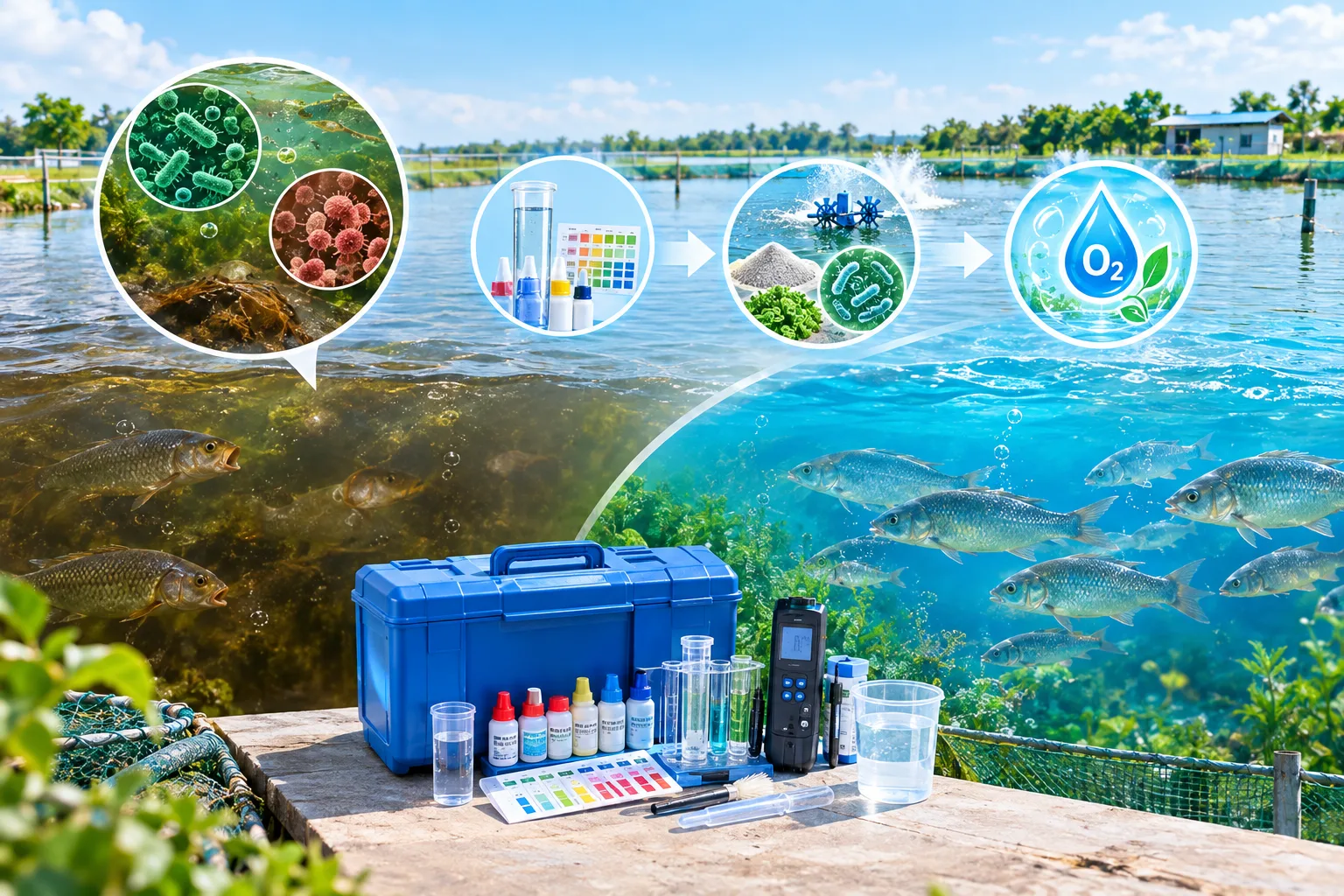
1. What harm do excessive ammonia nitrogen and nitrite in fish ponds cause?
Normal water quality reference standards for aquaculture:
- Ammonia nitrogen: ≤0.2 mg/L
- Nitrite: ≤0.05 mg/L
- Dissolved oxygen: ≥5 mg/L
- pH: 7.5–8.5
Ammonia nitrogen is divided into ionic ammonia and toxic non-ionic ammonia. The higher the pH, the stronger the toxicity of non-ionic ammonia. Excessive ammonia nitrogen damages the gills of fish and shrimp, causing gill filament swelling and congestion. Fish and shrimp become restless and stop feeding. Long-term high ammonia nitrogen damages internal organs and lowers immunity.
Nitrite is an intermediate product in the conversion of ammonia nitrogen to nitrate, and it accumulates in large amounts when the water body is short of oxygen. Nitrite destroys the oxygen-carrying capacity of fish and shrimp blood, causing “brown blood disease.” Externally, they may not appear to gasp for air, but fish and shrimp are in a state of internal hypoxia, with poor stress tolerance. Sudden death is very likely when weather changes... Jingzhou Agriculture...
Many ponds do not have only a single indicator exceeding the standard. Ammonia nitrogen, nitrite, dissolved oxygen, and pH often become abnormal in a linked manner. If only ammonia nitrogen is treated while dissolved oxygen and pH are ignored, water quality problems will soon recur.
2. Why do ammonia nitrogen and nitrite in fish ponds exceed the standard?
- Accumulation of leftover feed and feces: Excessive feeding, residual feed, and fish and shrimp excrement deposited at the bottom of the pond continuously decompose organic matter and produce ammonia nitrogen. This problem is more likely to occur in high-density aquaculture.
- Insufficient dissolved oxygen at the bottom layer: When the pond bottom is anoxic, nitrification is interrupted, ammonia nitrogen cannot be converted into non-toxic nitrate, and it remains at the nitrite stage, causing nitrite to continue rising.
- Aging bottom sediment: Ponds not cleared for many years have thick sludge, and organic matter at the bottom accumulates over the long term; after heavy rain, the bottom is stirred up and toxins are released in large amounts.
- Imbalance of bacteria and algae: Insufficient beneficial algae and beneficial bacteria weaken the water body’s self-purification capacity, blocking the nitrogen cycle.
- Drastic pH fluctuations: High pH amplifies the toxicity of ammonia nitrogen; too low pH leads to poor microbial activity and slow nitrogen conversion.
Key point: Dissolved oxygen is the foundation of the nitrogen cycle. Without sufficient dissolved oxygen, the effects of water conditioning and bottom improvement will be greatly reduced. Therefore, when testing water quality, you must not only test ammonia nitrogen and nitrite, but also dissolved oxygen and pH simultaneously to comprehensively judge the pond condition.
3. Emergency treatment methods for excessive ammonia nitrogen and nitrite
Tip: Before treatment, test the water quality first, confirm the values of each indicator, and choose a plan according to the severity of the exceedance. Do not blindly use large amounts of medication.
1. Emergency loss control, reduce continued toxin production
- Immediately reduce feeding; in severe cases, stop feeding for a short period to reduce new input of residual feed and feces;
- Turn on all aerators, prioritizing bottom-layer aeration, to increase dissolved oxygen at the pond bottom and restore nitrification;
- Change water in small amounts multiple times, with a single water change not exceeding 1/3 of the total water volume, to avoid stress in fish and shrimp.
2. Improve the bottom and detoxify, reduce toxins in the bottom layer
Use oxidative bottom modifiers such as potassium monopersulfate compound salt to oxidize organic matter in the pond bottom sludge and reduce the continuous release of ammonia nitrogen and nitrite; combine with organic acid detoxification to reduce water toxins and relieve stress in fish and shrimp.
3. Supplement beneficial bacteria and restore the water body’s nitrogen cycle
After aeration is in place, splash beneficial microorganisms such as nitrifying bacteria and compound Bacillus. Under sufficient dissolved oxygen, beneficial bacteria convert ammonia nitrogen into nitrite and then into non-toxic nitrate, degrading nitrogen from the root. Cooperate by stabilizing the algal phase; algae absorb nitrate, forming a complete nitrogen cycle.
4. Continuous monitoring to prevent indicator rebound
After emergency treatment, do not judge water quality only by visual inspection of water color. It is necessary to sample and test ammonia nitrogen, nitrite, dissolved oxygen, and pH for several consecutive days, track indicator changes, and adjust the plan according to the test data. Many ponds improve briefly after water conditioning, but the indicators rebound again within a few days. This is due to a lack of continuous water quality monitoring.
4. Daily prevention: regular testing to avoid outbreaks of ammonia nitrogen and nitrite
Core principle of aquaculture management: Prevention is greater than emergency response. By the time fish and shrimp become diseased or gasp for air, losses have already occurred.
- Regularly test water quality: it is recommended to test once every 7–10 days; during high-temperature seasons, before and after heavy rain, and during peak feeding periods, increase testing frequency; focus on monitoring four indicators: ammonia nitrogen, nitrite, dissolved oxygen, and pH.
- Reasonably control feeding and adjust the amount according to feeding conditions to reduce residual feed.
- Regularly improve the bottom to reduce the accumulation of organic matter in pond sludge.
- Maintain a stable bacterial and algal phase and keep sufficient dissolved oxygen in the water body.
Pain point: Many farmers face long cycles and high costs when sending water samples for testing, and cannot sample and test at any time. Rapid on-site testing at the pond is an urgent need for efficient aquaculture management.
5. Aquaculture water quality testing toolbox, rapid on-site water quality testing at the pond
Our aquaculture toolbox is specially designed for fish pond, shrimp pond, and other aquaculture farmers. One set of tools can quickly test four core water quality indicators on site: ammonia nitrogen, nitrite, dissolved oxygen, and pH.
✅ Take a water sample on site and get results quickly, without waiting for laboratory testing;
✅ Comes with reagents, colorimetric tubes, color charts, and sampling tools, ready to use upon opening the box;
✅ Simple to operate; farmers can complete testing independently, suitable for daily inspections, before and after heavy rain, and water quality monitoring before and after water conditioning;
✅ One set covers ammonia nitrogen, nitrite, dissolved oxygen, and pH, comprehensively evaluating the water environment and helping farmers accurately judge water quality problems and avoid blind water conditioning and medication.
Through this aquaculture toolbox, farmers can routinely monitor pond water quality, discover early signs of rising ammonia nitrogen and nitrite, intervene in time, reduce disease risk, and lower aquaculture losses.
6. Summary
Excessive ammonia nitrogen and nitrite in fish ponds are essentially caused by an imbalance in the water body’s nitrogen cycle, insufficient dissolved oxygen at the bottom layer, and excessive organic matter. The treatment approach: first increase oxygen to stop losses, then improve the bottom and detoxify, and finally supplement bacteria and stabilize algae. However, the premise of all water conditioning plans is to accurately grasp the real data of ammonia nitrogen, nitrite, dissolved oxygen, and pH in the pond.
Visual inspection of water color can only serve as a rough reference. To precisely control water quality, regular testing is needed. Equipped with an aquaculture water quality testing toolbox, farmers can achieve independent rapid testing at the pond, detect and handle problems early, reduce aquaculture risks caused by excessive ammonia nitrogen and nitrite, and ensure healthy growth of fish and shrimp.
If you need to know the detailed parameters and operation videos of the aquaculture toolbox, welcome to contact us for consultation.