
Introduction
Product Definition
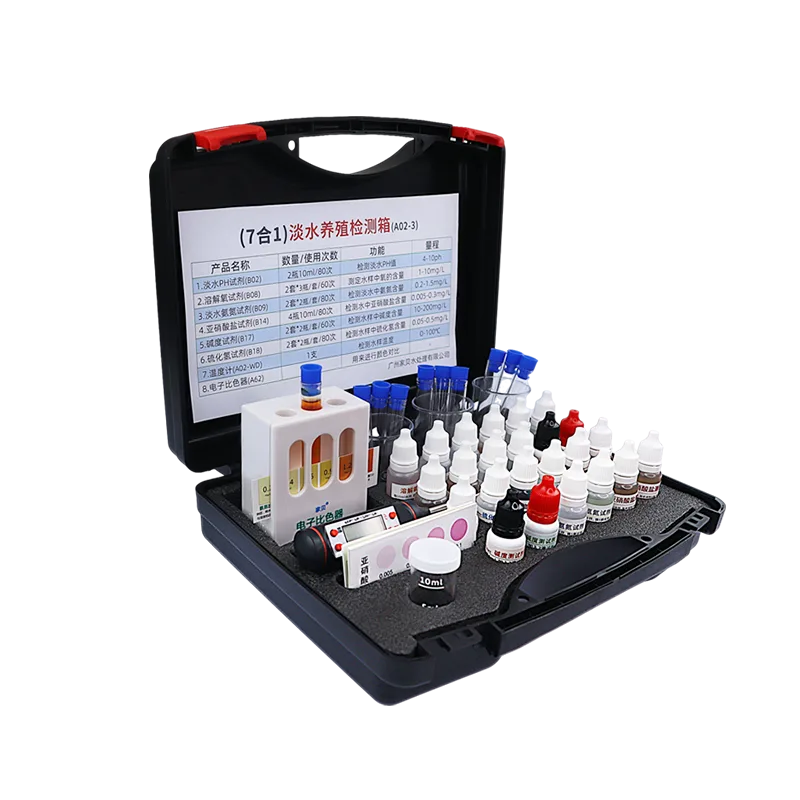
The A02-3 7-in-1 Freshwater Aquaculture Testing Kit is a rapid water quality testing kit specifically designed for freshwater aquaculture. It integrates seven commonly used testing functions for freshwater farming—pH, dissolved oxygen, ammonia nitrogen, nitrite, alkalinity, hydrogen sulfide, and temperature—into one portable case, and comes with corresponding test reagents, a thermometer, an electronic color comparator, and measuring cups. Users can complete water sample collection, reagent reaction, and colorimetric reading on site to stay informed of the status of key water quality parameters.
Product Features
- Integrated testing of seven indicators: One testing kit covers seven key parameters in freshwater aquaculture water monitoring, reducing the cost of purchasing multiple devices.
- Electronic color comparator for reading: The electronic color comparator (A62) performs color comparison on the reacted water sample, reducing errors caused by visual interpretation.
- Sufficient test counts: Each reagent supports 60–80 tests, meeting the continuous monitoring needs of multiple ponds and batches on a farm.
- Portable case storage: Reagent bottles, thermometer, color comparator, and measuring cups are all placed together in the testing case for convenient carrying and field operations.
- Designed for freshwater aquaculture: Reagent formulations match the characteristics of freshwater bodies and are designed based on water quality variation patterns in freshwater farming.
Core Specifications
The testing kit configuration and measurement ranges are as follows:
- Freshwater pH Reagent (B02): 2 bottles × 10 mL, 80 tests, range 4–10 pH
- Dissolved Oxygen Reagent (B08): 2 sets × 3 bottles/set, 60 tests, range 1–10 mg/L
- Freshwater Ammonia Nitrogen Reagent (B09): 2 sets × 2 bottles/set, 80 tests, range 0.2–1.5 mg/L
- Nitrite Reagent (B14): 4 bottles × 10 mL, 80 tests, range 0.005–0.3 mg/L
- Alkalinity Reagent (B17): 2 sets × 2 bottles/set, 60 tests, range 10–200 mg/L
- Hydrogen Sulfide Reagent (B18): 2 sets × 2 bottles/set, 80 tests, range 0.05–0.5 mg/L
- Thermometer (A02-WD): 1 piece, range 0–100 °C
- Electronic Color Comparator (A62): 1 unit, used for color comparison of developed water samples
- Measuring cups: 3 pieces, for water sample collection and testing operations
Application Scenarios
- Daily water quality inspection of ponds for freshwater fish, shrimp, crabs, and other aquatic species
- On-site rapid testing of multiple ponds at aquaculture farms
- Regular water quality assessment for aquariums and ornamental fish farming
- Basic water quality analysis in aquaculture experiments and scientific research/teaching activities
- Water quality monitoring of aquaculture water sources and discharge water
FAQ
Q: What parameters can the A02-3 7-in-1 Freshwater Aquaculture Testing Kit detect?
A: This testing kit can detect pH, dissolved oxygen, ammonia nitrogen, nitrite, alkalinity, hydrogen sulfide, and temperature in freshwater aquaculture water—7 parameters in total.
Q: How many tests can each reagent perform?
A: The pH reagent supports 80 tests, the dissolved oxygen reagent supports 60 tests, the ammonia nitrogen reagent supports 80 tests, the nitrite reagent supports 80 tests, the alkalinity reagent supports 60 tests, and the hydrogen sulfide reagent supports 80 tests.
Q: What is the function of the electronic color comparator?
A: The electronic color comparator (A62) electronically compares the color of the reacted water sample against standard color scales, helping to obtain more accurate water quality concentration readings.
Q: Can this testing kit be used for marine aquaculture testing?
A: No. This product is a freshwater aquaculture testing kit. All reagents are formulated for freshwater conditions and are not suitable for marine or brackish water aquaculture environments.
Related Terms
- Colorimetry: A testing method that determines the concentration of a substance by comparing the color developed after the sample reacts with the reagent against standard color scales.
- Dissolved Oxygen (DO): The content of oxygen dissolved in water in molecular form, expressed in mg/L. It is an important indicator of the self-purification capacity of aquaculture water and the living conditions of aquatic organisms.
- Ammonia Nitrogen: The nitrogen content present in water as free ammonia (NH₃) and ammonium ions (NH₄⁺). High concentrations are toxic to aquatic organisms.
- Nitrite: An intermediate product of ammonia nitrogen nitrification. Excessive levels reduce the oxygen-carrying capacity of aquatic organisms' blood, making it an important indicator in aquaculture water quality monitoring.
- Alkalinity: The total amount of alkaline substances in a water sample that can react with strong acids. It reflects the buffering capacity of the water body and is usually expressed in mg/L (as CaCO₃).
- Hydrogen Sulfide: A toxic gas produced by the decomposition of organic matter under anaerobic conditions. It is highly toxic to aquatic organisms and is one of the indicators of sediment and water quality deterioration.
- pH Value: An indicator of the acidity or alkalinity of a water sample. The suitable pH range for freshwater aquaculture is generally between 6.5 and 8.5.
- Electronic Color Comparator: An instrument that uses the photoelectric colorimetric principle to quantitatively compare the color of a developed sample, helping to improve the accuracy of visual color comparison.