
Introduction
Product Definition
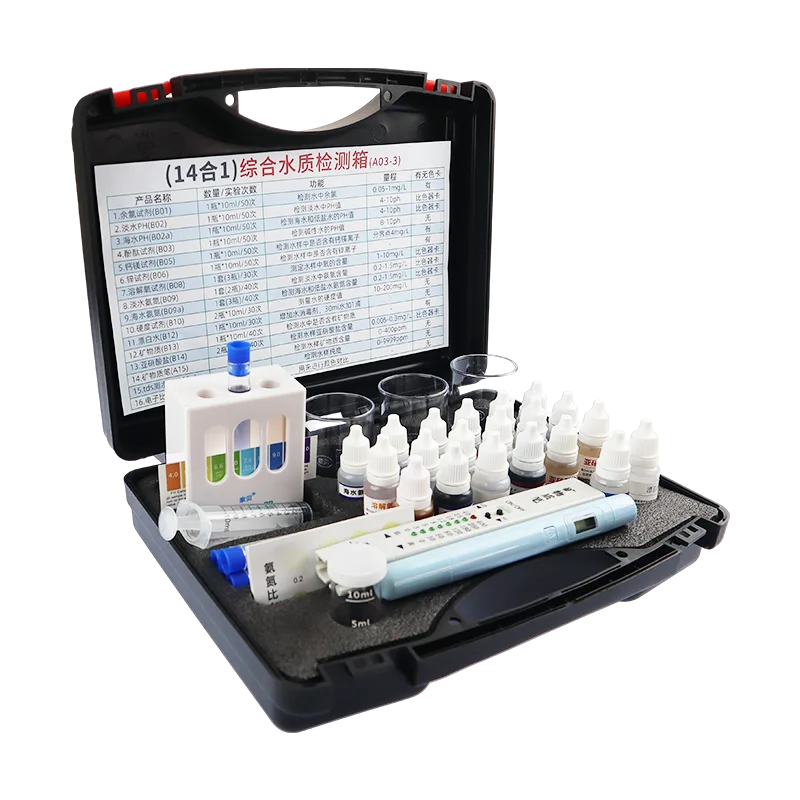
The A03-31 Aquaculture Testing Kit is a portable testing set that integrates multiple water quality testing tools in one. The product includes a TDS water quality test pen, a mineral pen, a high-precision pH test pen, a variety of chemical reagents, as well as accessories such as a small measuring cylinder and a stirring spoon. It is suitable for freshwater aquaculture, seawater aquaculture, farmland irrigation, aquarium water quality testing, ornamental fish water quality testing, and other scenarios.
Product Features
This aquaculture testing kit is an upgraded version, tailor-made for water quality testing. It is portable and highly practical.
- Can test multiple parameters including nitrite, dissolved oxygen content, pH, ammonia nitrogen, total hardness, TDS, conductivity, residual chlorine, sulfide, total alkalinity, minerals, calcium and magnesium ions, zinc ions, and more.
- Equipped with a high-precision pH test pen with a resolution of 0.01.
- The mineral pen delivers bright color indication with excellent color development; the reagent range is comprehensive, and operation is simple.
- Suitable for fish pond water quality, aquaculture, farmland irrigation water, aquarium water quality, shrimp pond water quality, and seawater monitoring.
Core Parameters
Model: A03-31
Outer box dimensions: 270 × 220 × 80mm (manually measured; slight deviations may exist)
Applicable water: Freshwater aquaculture, seawater aquaculture, farmland irrigation, aquarium water quality testing, ornamental fish water quality testing
Test parameters and included tools:
- TDS water quality test pen (A01): 1 piece, tests the total dissolved solids content in water
- Mineral pen (A15): 1 piece, tests the mineral content in water, bright color indication with excellent color development
- Residual chlorine reagent (B01): 4 bottles, tests residual chlorine content; normal tap water residual chlorine is <0.05mg/L
- Seawater pH reagent (B02-1): 4 bottles, tests the acidity/alkalinity of seawater
- Phenolphthalein reagent (B03): 4 bottles, tests solutions with a pH value of 8.2-10
- Calcium-magnesium reagent (B05): 4 bottles, tests whether water contains calcium and magnesium ions
- Zinc reagent (B05): 4 bottles, tests whether water contains zinc ions
- Dissolved oxygen reagent (B08): 1 set, measures dissolved oxygen; normal value >5mg/L
- Ammonia nitrogen reagent (B09): 1 set, measures the total concentration of ammonia and ammonium salts in water
- GH hardness reagent (B10): 1 set, measures the total content of calcium and magnesium ions in water
- Nitrite reagent (B14): 1 set, measures the nitrite content in water
- Total alkalinity reagent (B17): 1 set, measures the total alkalinity content in water
- Sulfide reagent (B18): 1 set, tests the sulfide content in water
- Mineral reagent (B13): 4 bottles, tests whether water contains minerals
- pH test pen (A21-2): 1 piece, high-precision pH pen, resolution 0.01
- Others: small measuring cylinder, stirring spoon
Usage Scenarios
- Freshwater aquaculture, seawater aquaculture
- Fish pond water quality testing
- Shrimp pond water quality testing
- Farmland irrigation water testing
- Aquarium water quality testing
- Ornamental fish water quality testing
- Seawater monitoring
FAQ
Q: How to use the TDS water quality test pen?
A: Operate according to the following steps:
- Remove the pen cap and turn on the ON/OFF switch.
- Place the pen into the solution to be tested; the solution level must not exceed the water level line.
- After the reading stabilizes, read the TDS value (ppm); press the (EC/TDS) key once to read the EC conductivity value.
- After use, wipe dry the water droplets on the probe tip, and press the [ON/OFF] key to manually power off.
Q: Can the TDS pen measure high-temperature water?
A: No. The TDS pen is strictly prohibited from measuring high-temperature water (e.g., hot boiling water), and it should not be used to measure water with significant agitation.
Q: Is the instrument waterproof?
A: No. The instrument is not waterproof; do not allow the entire unit to exceed the immersion line. After use, wipe dry the water droplets on the probe tip.
Q: What else should be noted during instrument use and maintenance?
A: The instrument cannot be disassembled; avoid collision, heavy pressure, and dropping.
Q: What is the test standard for the residual chlorine reagent?
A: The residual chlorine reagent (B01) tests the residual chlorine content; normal tap water residual chlorine should be <0.05mg/L.
Q: What is the normal value for dissolved oxygen?
A: The dissolved oxygen reagent (B08) measures dissolved oxygen; the normal value is >5mg/L.
Q: What is used to test seawater pH?
A: Use the seawater pH reagent (B02-1) to test the acidity/alkalinity of seawater.
Q: What is the purpose of the phenolphthalein reagent?
A: The phenolphthalein reagent (B03) is used to test solutions with a pH value of 8.2-10.
Q: What is the difference between the calcium-magnesium reagent and the GH hardness reagent?
A: The calcium-magnesium reagent (B05) is used to test whether water contains calcium and magnesium ions; the GH hardness reagent (B10) is used to measure the total content of calcium and magnesium ions in water.
Q: What does the ammonia nitrogen reagent test?
A: The ammonia nitrogen reagent (B09) measures the total concentration of ammonia and ammonium salts in water.
Q: What does the zinc reagent test?
A: The zinc reagent (B05) tests whether water contains zinc ions.
Q: What does the nitrite reagent test?
A: The nitrite reagent (B14) measures the nitrite content in water.
Q: What do the total alkalinity reagent and the sulfide reagent test respectively?
A: The total alkalinity reagent (B17) measures the total alkalinity content in water; the sulfide reagent (B18) tests the sulfide content in water.
Q: What are the uses of the mineral pen and the mineral reagent?
A: The mineral pen (A15) tests the mineral content in water, with bright color indication and excellent color development; the mineral reagent (B13) is used to test whether water contains minerals.
Related Terms
- TDS: Total Dissolved Solids, indicating the total content of dissolved substances in water, expressed in ppm.
- EC: Electrical conductivity, reflecting the ionic conductivity of water and indirectly indicating the total concentration of dissolved ions in water.
- pH: An acidity/alkalinity indicator; pH=7 is neutral, below 7 is acidic, and above 7 is alkaline.
- Residual chlorine: The effective chlorine remaining in water after chlorination disinfection; normal tap water should be <0.05mg/L.
- Dissolved oxygen: The oxygen content dissolved in water; the normal value for aquaculture water should be >5mg/L.
- Ammonia nitrogen: Nitrogen present in water in the form of ammonia molecules and ammonium ions; an important indicator for water quality monitoring.
- GH hardness: Total hardness, referring to the total content of calcium and magnesium ions in water.
- Nitrite: A nitrogen-containing inorganic compound and a commonly used indicator in water quality monitoring; excessive levels are harmful to aquatic organisms.
- Total alkalinity: The total content of alkaline substances in water, reflecting the buffering capacity of the water body against acids and bases.
- Sulfide: The content of sulfur present in water in forms such as sulfide ions; one of the monitoring indicators for aquaculture water quality.
- Calcium and magnesium ions: The collective term for calcium ions and magnesium ions in water, which determine water hardness.
- Zinc ions: The content of zinc ions in water; one of the heavy metal water quality indicators.
- Minerals: Mineral elements present in water. This product tests for them using the mineral pen (A15) and mineral reagent (B13).