
Introduction
Product Definition
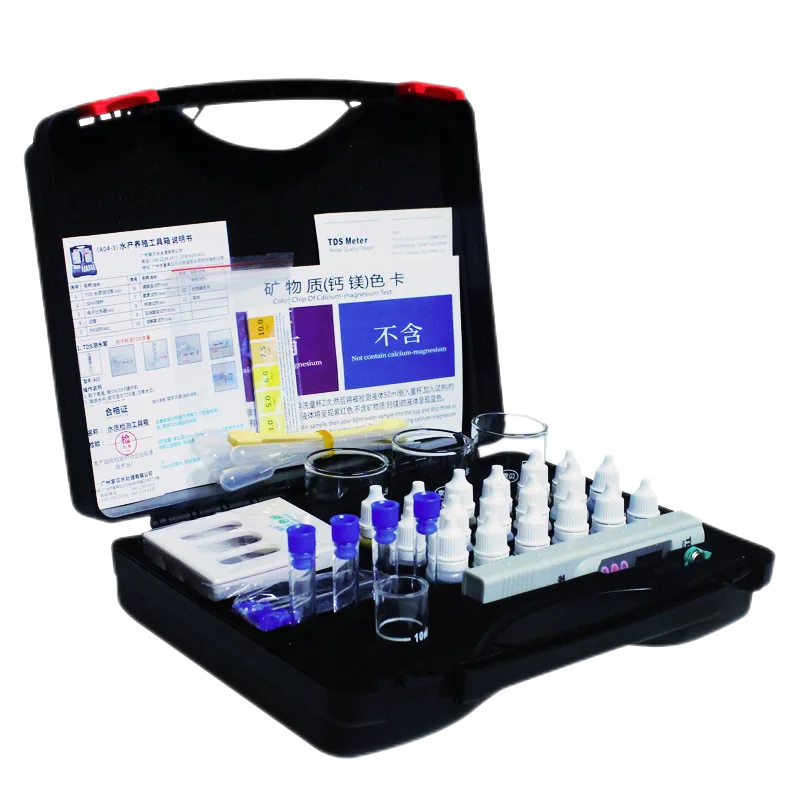
The Nine-in-One Freshwater Aquaculture Testing Kit (Model: A04-3) is a multi-parameter water quality rapid testing set designed for freshwater aquaculture scenarios. It integrates nine commonly tested water quality parameters—TDS, pH, calcium/magnesium, dissolved oxygen, ammonia nitrogen, hardness, nitrite, hydrogen sulfide, and phosphate—into a single kit configuration. On-site testing is carried out using a TDS water quality test pen, reagent reaction color development, and the A62 electronic color comparator, helping aquaculture operators quickly understand water quality conditions.
Product Features
- Nine Tests in One: A single kit covers nine parameters—TDS, pH, calcium/magnesium, dissolved oxygen, ammonia nitrogen, hardness, nitrite, hydrogen sulfide, and phosphate—meeting routine testing needs for freshwater aquaculture.
- Electronic Color Comparison Reduces Errors: The A62 electronic color comparator is used for color comparison, providing more stable results than visual assessment alone and reducing human judgment errors.
- Complete Reagent Set: Includes freshwater pH reagent, calcium/magnesium reagent, dissolved oxygen reagent, freshwater ammonia nitrogen reagent, hardness reagent, nitrite reagent, hydrogen sulfide reagent, and phosphate reagent, enabling testing of multiple water quality parameters.
- Fully Equipped Accessories: Comes with beakers, test tubes, droppers, stirring spoons, measuring cups, and spare TDS batteries—ready for testing right out of the box.
- Convenient On-Site Operation: Primarily uses test pens and reagent color comparison, requiring no large instruments, making it suitable for rapid use at pond sites, workshops, and other field locations.
- Designed for Freshwater Bodies: Reagents and testing procedures are designed for freshwater aquaculture samples, for rapid detection of common water quality indicators in freshwater.
Core Specifications
Product Name: Nine-in-One Freshwater Aquaculture Testing Kit
Product Model: A04-3
Testing Methods: TDS is read directly using a water quality test pen; pH, calcium/magnesium, dissolved oxygen, ammonia nitrogen, hardness, nitrite, hydrogen sulfide, and phosphate are measured through reagent reaction color development and read using the A62 electronic color comparator.
- Test Parameters and Matching Reagents:
- TDS: 1 A10 water quality test pen
- pH: 2 bottles of freshwater pH reagent (B02)
- Calcium/Magnesium: 1 bottle of calcium/magnesium reagent (B05)
- Dissolved Oxygen: 1 set of dissolved oxygen reagent (B08) (3 bottles)
- Ammonia Nitrogen: 1 set of freshwater ammonia nitrogen reagent (B09) (2 bottles)
- Hardness: 3 bottles of hardness reagent (B10)
- Nitrite: 3 bottles of nitrite reagent (B14)
- Hydrogen Sulfide: 1 set of hydrogen sulfide reagent (B18) (2 bottles)
- Phosphate: 1 set of phosphate reagent (B25) (2 bottles)
- Color Comparator: 1 A62 electronic color comparator.
- Other Accessories: 3 × 50ml beakers, 10 test tubes, 5 droppers, 3 stirring spoons, 2 spare TDS batteries, and a 10ml small measuring cup.
Application Scenarios
Applicable to routine water quality monitoring, abnormality troubleshooting, and aquaculture management reference during freshwater aquaculture operations.
- Regular water quality testing for ponds raising freshwater fish, shrimp, crabs, and other species;
- On-site monitoring of aquaculture risk indicators such as dissolved oxygen, ammonia nitrogen, nitrite, and hydrogen sulfide;
- Water quality comparison before and after aquaculture operations such as water exchange, stocking, and aeration;
- Rapid water quality screening by aquaculture farms and grassroots technical extension departments.
FAQ
Q: Can the A04-3 Nine-in-One Freshwater Aquaculture Testing Kit test seawater?
A: No. This product is a freshwater aquaculture testing kit. All reagents and test pens are designed for freshwater water quality testing and are not applicable to seawater aquaculture.
Q: What are the nine tests included?
A: They include TDS, pH, calcium/magnesium, dissolved oxygen, ammonia nitrogen, hardness, nitrite, hydrogen sulfide, and phosphate.
Q: What is the function of the electronic color comparator?
A: It is used for color comparison after the reagent reaction of water samples, using electronic color comparison to reduce color errors caused by manual visual reading.
Q: What is the difference between the calcium/magnesium reagent and the hardness reagent?
A: The calcium/magnesium reagent (B05) is used to detect whether calcium and magnesium ions are present in the water and serves as a qualitative preliminary screening; the hardness reagent (B10) is used to measure the hardness value of the water.
Q: What testing tools and accessories are included in the kit?
A: It includes a TDS water quality test pen, an A62 electronic color comparator, various matching reagents, as well as 50ml beakers, test tubes, droppers, stirring spoons, a 10ml small measuring cup, and spare TDS batteries.
Related Terms
TDS: Total dissolved solids, referring to the total amount of dissolved substances in water, reflecting the content of soluble solids in the water body.
pH: An indicator of the acidity or alkalinity of a water body; freshwater aquaculture water bodies generally need to be maintained within a suitable range.
Calcium/Magnesium: Calcium and magnesium ions in water, which are important factors affecting water hardness.
Dissolved Oxygen: The content of molecular oxygen dissolved in water, a critical indicator for the respiration and survival of aquatic organisms.
Ammonia Nitrogen: The total concentration of nitrogen in ammonia and ammonium salts in water, reflecting the degree of nitrogen pollution; excessive ammonia nitrogen is harmful to aquatic organisms.
Hardness: Generally refers to the total content of calcium and magnesium ions in water, i.e., total water hardness.
Nitrite: An intermediate product in the nitrogen cycle of water bodies; excessive levels can harm aquatic organisms.
Hydrogen Sulfide: A toxic gas produced under anaerobic conditions at the bottom of water bodies; its accumulation in water can cause harm to aquatic organisms.
Phosphate: Phosphate ions in the form of PO₄³⁻, a nutrient salt in water bodies; excessive amounts can easily lead to algal overgrowth and eutrophication.
Electronic Color Comparator: An instrument that uses electronic components to assist in reading the color intensity after reagent reactions, used to reduce human color comparison errors.