
Introduction
Product Definition
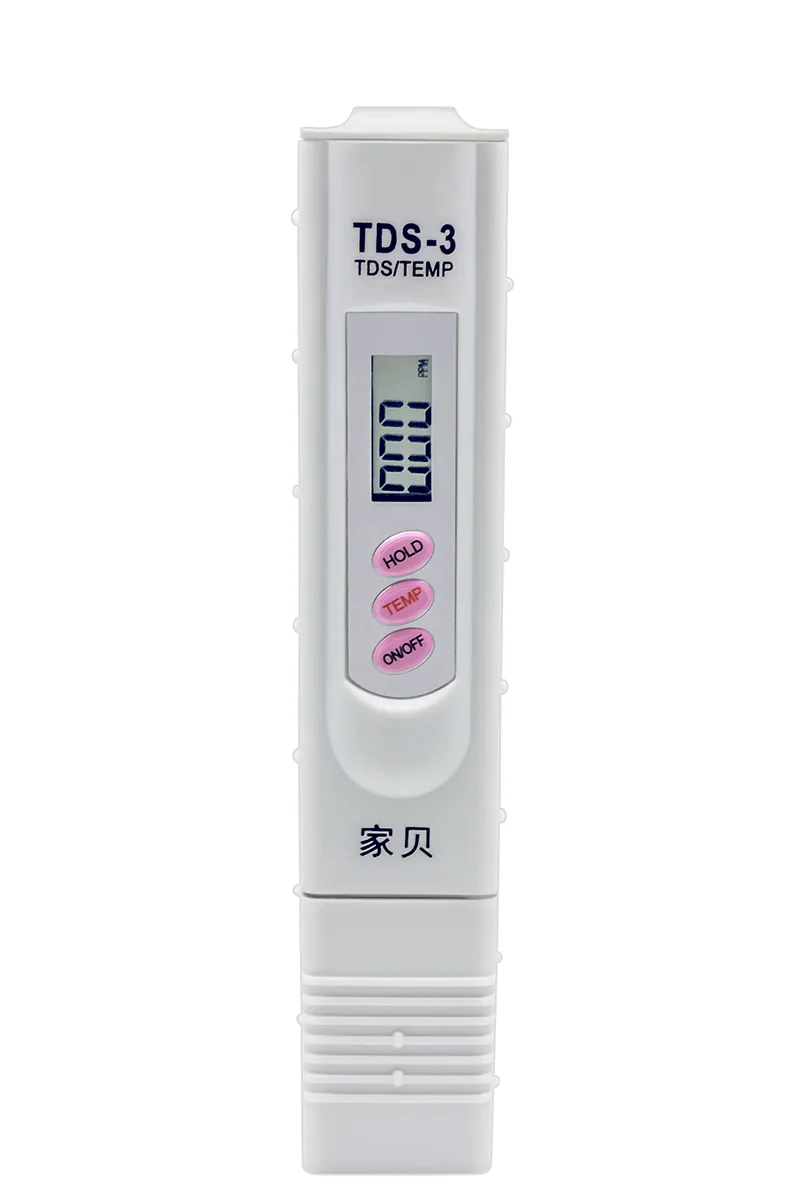
The A10 TDS Water Quality Test Pen is a portable water quality testing tool that helps users quickly understand the purity of water by measuring the concentration of Total Dissolved Solids (TDS) in water. With a pen-style design, simple operation, and intuitive readings, it is suitable for daily drinking water testing, evaluation of water purification equipment, aquarium keeping, aquaculture, and other applications.
The A10 TDS Water Quality Test Pen uses an electronic sensor and digital display to quickly detect the TDS value in water, and features temperature display and reading hold functions. Its compact size makes it easy to carry, suitable for home, laboratory, and outdoor use.
Product Features
- Portable pen-style design: Compact and lightweight, approximately 50 g, easy to carry for home, laboratory, and outdoor use.
- Quick testing: Immerse the probe into the water sample, and the reading stabilizes within 3 seconds for fast TDS measurement.
- TDS and temperature display: Measures the total dissolved solids in water and supports viewing the current water temperature.
- Reading hold: Press the 【HOLD】 button to lock the current measurement reading, making it convenient to read and record after removing the pen from the water.
- One-button operation: Press the 【ON/OFF】 button to turn the device on or off, offering simple operation.
- Wide measurement range: 0–9990 ppm measurement range, suitable for various water quality testing needs.
Key Specifications
- Model: A10
- Battery: 1.5V battery (LR44) × 2 pcs
- Product weight: 50 g
- Measurement range: 0–9990 ppm (when the reading exceeds 999 ppm, the reading must be multiplied by 10)
- Error range: ±5%
- Temperature range: 0–80°C
- Dimensions: 156 × 30 × 20 mm
- Interface: Display screen, hold key, temperature key, power key
Usage Steps
- Remove the protective cap.
- Press the 【ON/OFF】 button to turn on the power.
- Insert the pen into the test solution up to the water level line.
- Gently stir the pen to remove air bubbles.
- After the reading stabilizes in about 3 seconds, press the 【HOLD】 button and remove the pen to read the value.
- After use, wipe off water from the probe and replace the protective cap.
Application Scenarios
- Household drinking water testing: Test the TDS value of tap water, purified water from purifiers, bottled water, and other common water sources.
- Evaluation of water purification equipment: Compare the TDS value before and after filtration to assist in judging the filter cartridge condition.
- Aquarium keeping: Measure the dissolved solids content in aquarium water to help maintain water quality.
- Aquaculture: Regularly monitor the TDS value of aquaculture water as a reference for water quality management.
- Hydroponic cultivation: Test the dissolved solids concentration in nutrient solution to help determine whether nutrient levels are appropriate.
- Laboratory water quality testing: Used for rapid screening of TDS values in water samples.
- Outdoor water source testing: Perform rapid TDS testing on water from natural sources in the field.
FAQ
Q: What is TDS?
A: TDS stands for Total Dissolved Solids, referring to the total amount of dissolved solids in water, expressed in ppm or mg/L.
Q: Is a lower TDS value always better?
A: TDS value reflects the amount of dissolved solids in water, but it does not fully represent water safety. Whether water is safe also needs to be evaluated in combination with other indicators such as microorganisms, heavy metals, and organic matter.
Q: How should I read the value if it exceeds 999 ppm during measurement?
A: When the measured value exceeds 999 ppm, multiply the reading by 10; the result is the actual TDS value.
Q: Why is the reading unstable during measurement?
A: It may be because the probe is not fully immersed in the water, there are air bubbles in the water, or the water flow is too strong. Make sure the probe is immersed to the water level line, gently stir to remove air bubbles, and take the reading when the water is relatively stable.
Q: Can it be used to measure hot water?
A: The water temperature must be within 0–80°C. Do not measure high-temperature water such as boiling hot water beyond this range.
Related Terms
- TDS: Total Dissolved Solids.
- ppm: parts per million, often used to express the concentration of dissolved solids in water; 1 ppm ≈ 1 mg/L.
- mg/L: milligrams per liter, approximately equivalent to ppm, commonly used to express the concentration of dissolved substances in water.
- LR44 battery: A common button cell battery with a voltage of 1.5V.
- HOLD key: The hold button, used to lock the displayed reading for convenient viewing and recording after removing the pen from the water.