
Introduction
Product Definition
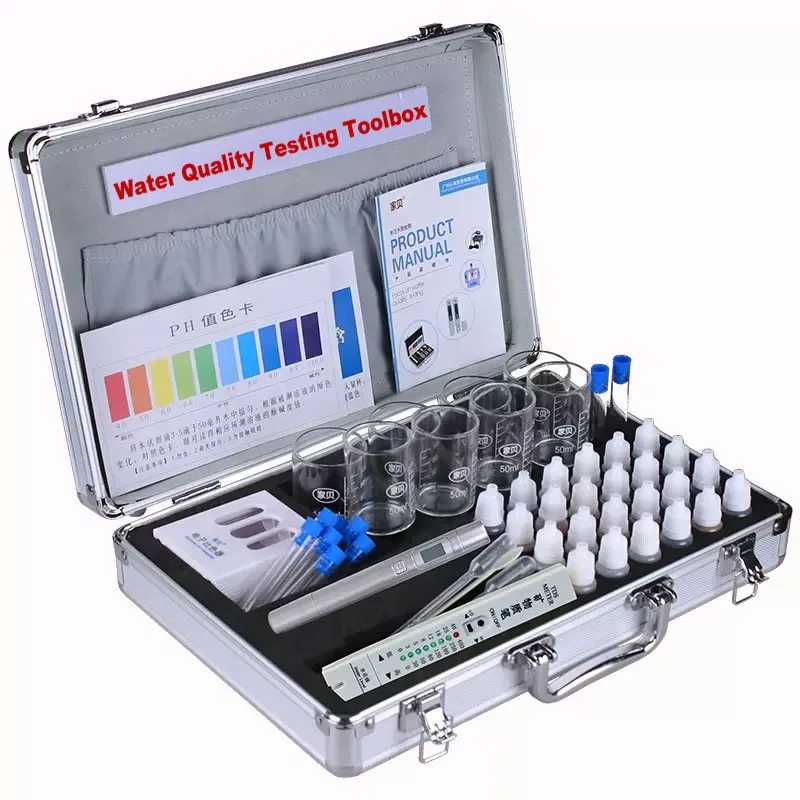
The A41-8 Comprehensive Water Quality Testing Kit is a multi-parameter water quality testing suite that integrates a TDS water quality test pen, an electronic color comparator, a mineral test pen, and multiple chemical reagents. It can rapidly detect total dissolved solids, residual chlorine, pH, hardness, nitrite, minerals, heavy metals, dissolved oxygen, ammonia nitrogen, and other indicators in water. It is suitable for household drinking water testing, water purifier effect demonstrations, and water quality comparison experiments.
Product Features
- Wide range of detection parameters covering physical/chemical indicators, pollution indicators, and functional indicators, providing more comprehensive and accurate testing.
- Comes standard with 24 bottles of testing reagents, plus one set each of dissolved oxygen reagent and ammonia nitrogen reagent, ensuring a complete reagent lineup.
- Rich accessory package including a TDS water quality test pen, electronic color comparator, mineral test pen, multiple beakers, and auxiliary tools.
- The electronic color comparator allows color comparison under normal lighting, effectively reducing errors and improving reading accuracy.
- Capable of demonstrating water purifier and water dispenser functions, such as blue ink/industrial pollution reagent turning brown in alkaline conditions and returning to blue after neutralization.
- Easy to operate, suitable for household users, sales personnel, and science education.
Core Specifications
- Product Name: Comprehensive Water Quality Testing Kit
- Model: A41-8
- Reagent Configuration: Residual Chlorine Reagent ×6, pH Reagent ×6, Phenolphthalein Reagent ×1, Hardness Reagent ×1, Nitrite Reagent ×2, Antioxidant Reagent ×1, Bleach/Chlorine-Enhancing Reagent ×1, Mineral Reagent ×1, Phenol Blue Reagent ×1, Blue Ink/Industrial Pollution Reagent ×1, Heavy Metal Test Reagent ×1, Calcium-Magnesium Reagent ×1, Active Water Reagent ×1; plus 1 set of Dissolved Oxygen Reagent and 1 set of Ammonia Nitrogen Reagent.
- Test Parameters: TDS, residual chlorine, pH, total hardness, nitrite, antioxidant capacity, minerals, heavy metals, calcium/magnesium ions, active water, dissolved oxygen, ammonia nitrogen, etc.
- Reference Range: Tap water TDS is generally 50-300 PPM; normal tap water residual chlorine >0.05 mg/L; suitable drinking water pH range is 7.1-8.2; normal dissolved oxygen level is 5-8 mg/L.
- Accessory List: TDS Water Quality Test Pen (A50) ×1, Electronic Color Comparator (A62) ×1 set, Mineral Test Pen (A15) ×1, 100ml Beaker ×4, 50ml Beaker ×4, Large Color Card ×2, Small Dropper ×2, Stirring Spoon ×2, Transparent Bottle ×1.
Usage Scenarios
- Rapid routine water quality testing of household tap water, purified water, and mineral water.
- Demonstration and functional verification of water purifiers and water dispensers.
- Water quality comparison experiments and science education with different water samples.
- Specific testing of heavy metals, minerals, and other parameters in RO water purifiers or purified water.
- Preliminary water quality screening of outdoor water sources (e.g., residual chlorine, pH, hardness, ammonia nitrogen).
FAQ
Q: What are the main accessories included in the A41-8 Comprehensive Water Quality Testing Kit?
A: It includes 1 TDS water quality test pen, 1 electronic color comparator set, 1 mineral test pen, 4 100ml beakers, 4 50ml beakers, 2 large color cards, 2 small droppers, 2 stirring spoons, and 1 transparent bottle. It comes standard with 24 bottles of testing reagents, plus 1 set of dissolved oxygen reagent and 1 set of ammonia nitrogen reagent.
Q: How can I determine whether the residual chlorine in tap water is acceptable?
A: Use the Residual Chlorine Reagent (B01) to test the residual chlorine content. Normal tap water should contain residual chlorine >0.05 mg/L.
Q: What is the suitable pH range for drinking water for the human body?
A: The suitable pH range for drinking water is 7.1-8.2. You can use the pH Reagent (B02) to test the acidity or alkalinity of a water sample.
Q: What is the function of the electronic color comparator?
A: The Electronic Color Comparator (A62) helps perform color comparison under normal lighting, making test results more accurate and reducing visual errors.
Q: How should the color development result of the Active Water Reagent be interpreted?
A: Use the Active Water Reagent (B28) for testing. A red or pink color indicates the water sample is active water, while a yellow color indicates non-active water.
Q: What is the purpose of the Blue Ink/Industrial Pollution Reagent (B16)?
A: It is used for demonstrating the functions of water purifiers and water dispensers. It turns brown in alkaline conditions and returns to blue after neutralization, visually showing the filtration or reduction effect.
Q: What is the normal value of dissolved oxygen?
A: The Dissolved Oxygen Reagent (B08) measures the dissolved oxygen concentration in a water sample. Molecular oxygen dissolved in water is called dissolved oxygen, and the normal value is 5-8 mg/L.
Q: Which reagent is used to test for heavy metals in a water sample?
A: Use the Heavy Metal Test Reagent (B26), which is suitable for heavy metal testing of RO water purifier output or purified water.
Related Terms
- TDS: Total Dissolved Solids, reflecting the total content of dissolved substances in water, expressed in PPM.
- PPM: Parts per million, a concentration unit indicating one part of solute per million parts of solution by mass.
- Residual Chlorine: Free chlorine remaining in water, used to maintain disinfection effectiveness and must be kept at a certain concentration.
- pH: An acidity/alkalinity indicator, expressing the strength of acidity or alkalinity of an aqueous solution.
- Total Hardness: A comprehensive indicator of calcium and magnesium ion content in water.
- Nitrite: A nitrogen-containing compound and one of the important indicator parameters for water pollution.
- Dissolved Oxygen: Molecular oxygen dissolved in water, typically present at 5-8 mg/L in normal water bodies.
- Ammonia Nitrogen: The total concentration of nitrogen present in water in the form of ammonia and ammonium salts (expressed as N), affected by water temperature and pH.
- Heavy Metals: Metal elements with relatively high density or significant toxicity, such as lead, mercury, cadmium, and chromium, which are harmful to human health.
- Active Water: A type of water that can produce a color reaction when tested with specific reagents. In this testing kit, a red or pink color indicates active water.