
Introduction
Product Definition
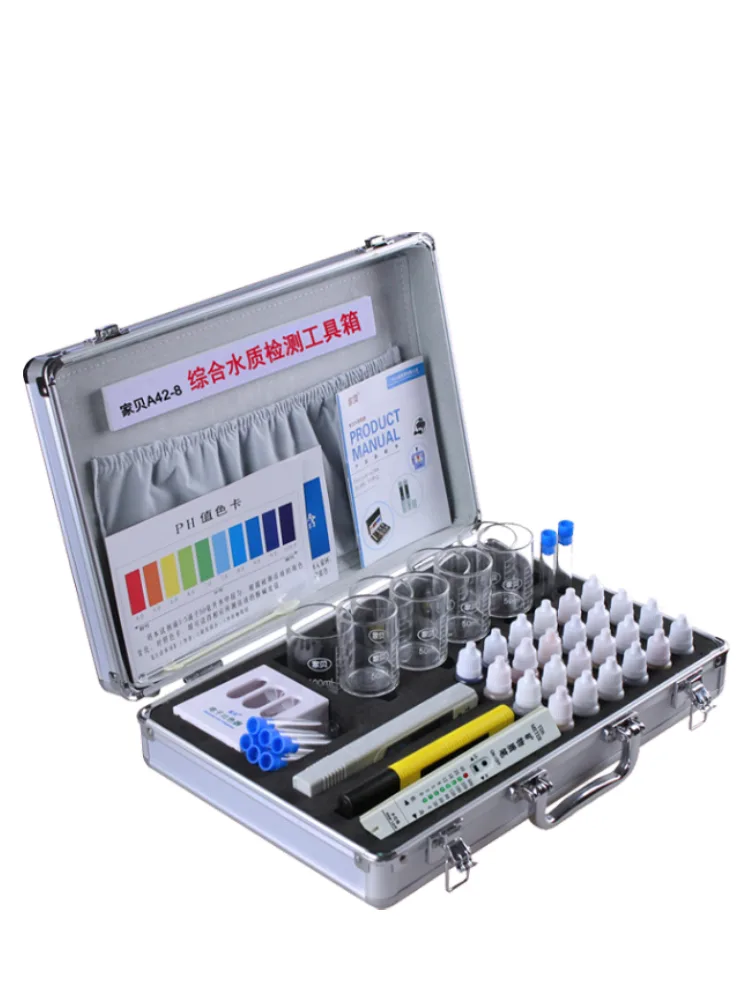
The A42-8 Comprehensive Water Quality Testing Toolbox is a multi-parameter rapid water quality testing kit. It integrates electronic test pens, chemical reagents, color comparators, and auxiliary tools into one toolbox, enabling detection or colorimetric assessment of total dissolved solids, pH, minerals, total hardness, residual chlorine, nitrite, ammonia nitrogen, dissolved oxygen, heavy metals, antioxidant capacity, active water, and other indicators in water. It is suitable for rapid household drinking water screening, water purifier function demonstrations, on-site preliminary water quality inspection, and water quality science education.
Product Features
- Multi-parameter coverage: Includes test pens and reagents, covering routine physicochemical indicators, mineral/hardness indicators, pollution indicators, and functional water demonstration indicators.
- Multiple detection methods: Electronic test pens provide direct readings; after color development, reagents are compared with color cards/electronic color comparators; multiple methods cross-validate each other.
- Ready to use out of the box: Comes standard with beakers, large color cards, small droppers, stirring spoons, and transparent bottles, making it easy to sample, add reagents, and compare colors.
- Convenient for demonstrations: Residual chlorine, mineral, blue ink/industrial pollution, and active water reagents can visually demonstrate the water treatment performance of water purifiers/water dispensers.
- Portable and organized: All testing tools are centrally stored in the toolbox, making it easy to carry and use on site.
Core Specifications
- Product model: A42-8.
- Test pens and color comparator: TDS water quality test pen (A50) ×1, mineral test pen (A15) ×1, pH test pen (A21-3) ×1, electronic color comparator (A62) ×1 set.
- Reagent configuration: Residual chlorine reagent (B01) ×6, pH reagent (B02) ×6, phenolphthalein reagent (B03) ×1, hardness reagent (B10A) ×1, nitrite reagent (B14) ×2, antioxidant reagent (B07) ×1, bleach/chlorine booster reagent (B12) ×1, mineral reagent (B13) ×1, phenol blue reagent (B15) ×1, blue ink/industrial pollution reagent (B16) ×1, heavy metal test reagent (B26) ×1, calcium-magnesium reagent (B05) ×1, active water reagent (B28) ×1, dissolved oxygen reagent (B08) ×1 set, ammonia nitrogen reagent (B09) ×1 set.
- Auxiliary configuration: 100ml beaker ×4, 50ml beaker ×4, large color card ×2, small dropper ×2, stirring spoon ×2, transparent bottle ×1.
- pH test pen specifications: Test range 0.00-14.00 pH, accuracy 0.01.
- Reference judgment values: Tap water residual chlorine >0.05 mg/L; normal dissolved oxygen value 5-8 mg/L; pH suitable for human consumption 7.1-8.2; common TDS range for tap water 50-300 PPM.
- Color development reference: Phenolphthalein reagent turns purple-red at pH 8-10; mineral reagent turning purple-red indicates the presence of minerals; active water reagent turning red/pink indicates active water and yellow indicates non-active water; blue ink/industrial pollution reagent turns brown when exposed to alkali and returns to blue after neutralization.
Application Scenarios
- Household drinking water testing: Test TDS, pH, residual chlorine, total hardness, nitrite, and other indicators in tap water, water purifier effluent, barreled water, etc.
- Water purifier/water dispenser demonstration: Use residual chlorine reagent, mineral reagent, blue ink/industrial pollution reagent, active water reagent, etc. to conduct comparison demonstrations between incoming and outgoing water.
- Pure water/purified water testing: Use heavy metal test reagent, etc. to determine whether heavy metals are present in pure water machine output or purified water samples.
- Water quality science education and teaching: Use intuitive methods such as reagent color development, test pen readings, and color card comparison to demonstrate water quality knowledge.
- Rapid on-site preliminary screening: Suitable for on-site reference testing of dissolved oxygen, ammonia nitrogen, nitrite, etc. in source water, pond water, aquaculture water, and other water samples.
FAQ
Q: What parameters can the A42-8 Comprehensive Water Quality Testing Toolbox detect?
A: It can detect TDS, pH, minerals, total hardness, residual chlorine, nitrite, ammonia nitrogen, dissolved oxygen, heavy metals, antioxidant capacity, active water, etc., and can use the calcium-magnesium reagent to determine whether calcium and magnesium ions are present in water.
Q: What is the difference between the pH test pen and pH reagent?
A: The pH test pen directly reads the acidity/alkalinity of a water sample through an electrode, with a test range of 0.00-14.00 and an accuracy of 0.01. The pH reagent determines acidity/alkalinity by comparing color development with a color card/color comparator. The pH value suitable for human consumption is 7.1-8.2.
Q: How does the residual chlorine reagent determine whether the residual chlorine in tap water is normal?
A: Add the residual chlorine reagent to the water sample according to the instructions, observe the color development, and compare it with the color card/color comparator. The residual chlorine content of normal tap water should be >0.05 mg/L.
Q: What are the respective functions of the mineral test pen and mineral reagent?
A: The mineral test pen is used to detect the mineral content in water; the mineral reagent is used to qualitatively determine whether minerals are present in a water sample. A purple-red color indicates the presence of minerals.
Q: What is the blue ink/industrial pollution reagent used for?
A: It is mainly used for water purifier and water dispenser function demonstrations: the water sample turns brown when exposed to alkali and returns to blue after neutralization, visually showing the pollution and neutralization process of the water sample.
Q: How is the active water reagent used for judgment?
A: After adding the active water reagent to the water sample, red or pink indicates that the sample is active water, while yellow indicates non-active water.
Q: What do the dissolved oxygen reagent and ammonia nitrogen reagent measure respectively?
A: The dissolved oxygen reagent is used to measure the dissolved oxygen concentration in a water sample, with a normal value of 5-8 mg/L. The ammonia nitrogen reagent is used to measure the total concentration of ammonia and ammonia salts in the water sample (as nitrogen). Ammonia is affected by water temperature and pH.
Q: What water samples is the heavy metal test reagent used for?
A: The heavy metal test reagent is mainly used for pure water machine or purified water testing to determine whether heavy metals are present in a water sample.
Related Terms
- TDS: Total dissolved solids, reflecting the total amount of dissolved substances in water, unit PPM; common range for tap water 50-300 PPM.
- pH: Acidity/alkalinity, range 0-14; the pH test pen in this kit has an accuracy of 0.01; pH suitable for human consumption is 7.1-8.2.
- Residual chlorine: The chlorine content remaining in water after disinfection; normal tap water residual chlorine is >0.05 mg/L.
- Total hardness: The total content of calcium and magnesium ions in water, detected using the hardness reagent.
- Nitrite: A nitrogen-containing compound and one of the reference indicators of water pollution.
- Ammonia nitrogen: The total concentration of ammonia and ammonia salts in water (as nitrogen), affected by water temperature and pH.
- Dissolved oxygen: Molecular oxygen dissolved in water, normal value 5-8 mg/L.
- Heavy metals: Metal elements that have adverse effects on the water environment and can be detected using the heavy metal test reagent.
- Antioxidant capacity: The ability of a water sample to resist oxidation, which can be quickly tested with the antioxidant reagent.
- Calcium and magnesium ions: Hardness ions in water; the calcium-magnesium reagent can detect their presence.
- Colorimetric method: A method that determines whether a component is present and its approximate content in a water sample by comparing the color developed by a reagent with a standard color card/color comparator.
- Active water: Determined in this kit using the active water reagent: red or pink indicates active water, while yellow indicates non-active water.