
Introduction
Product Definition
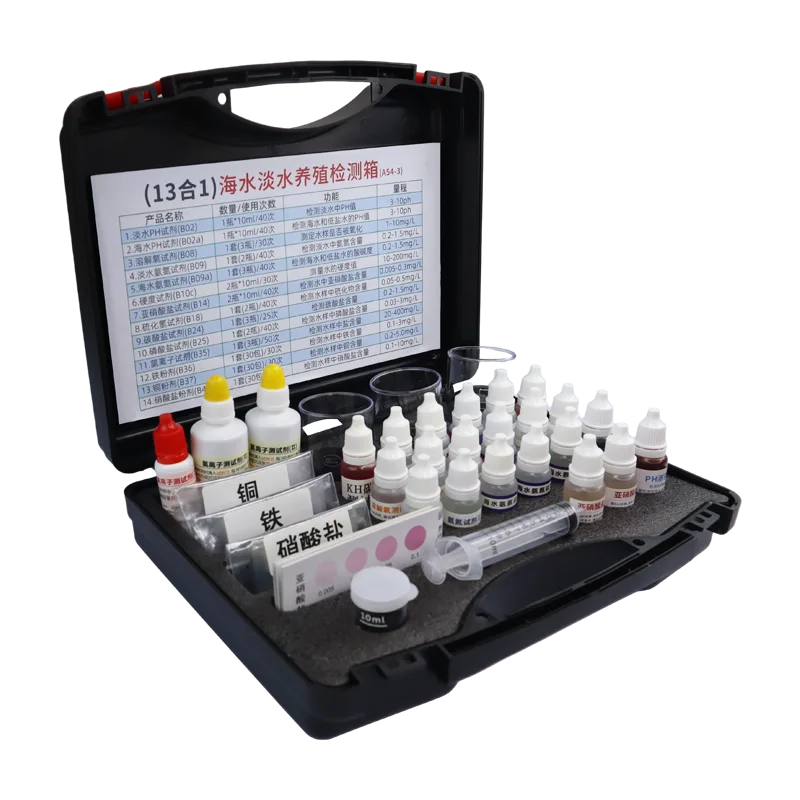
The A54-3 13-in-1 Seawater and Freshwater Aquaculture Testing Kit is a multi-parameter water quality testing tool designed for aquaculture scenarios. The kit integrates test reagents for freshwater/seawater pH, dissolved oxygen, freshwater/seawater ammonia nitrogen, hardness, nitrite, hydrogen sulfide, carbonate, phosphate, chloride, iron, copper, and nitrate into one unit, making it suitable for routine aquaculture water quality monitoring in seawater, freshwater, and low-salinity water bodies.
Product Features
- Multi-parameter coverage: Integrates common aquaculture water quality testing items to meet daily water quality management needs.
- Separate freshwater/seawater reagents: pH and ammonia nitrogen tests provide freshwater-type and seawater-type reagents respectively, adapting to water bodies of different salinities.
- Easy operation: Uses reagent color development and colorimetric reading, requiring no complex instruments.
- Portable storage: Reagents are centrally stored in a kit case, making it easy to carry to pond sites or aquaculture farms.
- Wide applicability: Suitable for seawater aquaculture, freshwater aquaculture, and low-salinity aquaculture scenarios.
- Assists management: Helps aquaculturists monitor key water quality indicators such as ammonia nitrogen, nitrite, hydrogen sulfide, and dissolved oxygen, allowing timely adjustment of management measures.
Core Specifications
Model: A54-3
Applicable water samples: Seawater, freshwater, brackish water
Test method: Reagent colorimetric method
Main test items and specifications:
- Freshwater pH reagent (B02): 1 bottle × 10 ml/40 tests, range 4-10 pH, for detecting pH in freshwater.
- Seawater pH reagent (B02a): 1 bottle × 10 ml/40 tests, range 4-10 pH, for detecting pH in seawater and brackish water.
- Dissolved oxygen reagent (B08): 1 set (3 bottles)/30 tests, range 1-10 mg/L, for measuring oxygen content in water samples.
- Freshwater ammonia nitrogen reagent (B09): 1 set (2 bottles)/40 tests, range 0.2-1.5 mg/L, for detecting ammonia nitrogen content in freshwater.
- Seawater ammonia nitrogen reagent (B09a): 1 set (3 bottles)/40 tests, range 0.2-1.5 mg/L, for detecting ammonia nitrogen content in seawater and brackish water.
- Hardness reagent (B10c): 2 bottles × 10 ml/30 tests, range 10-200 mg/L, for measuring water hardness.
- Nitrite reagent (B14): 2 bottles × 10 ml/40 tests, range 0.005-0.3 mg/L, for detecting nitrite content in water.
- Hydrogen sulfide reagent (B18): 1 set (2 bottles)/40 tests, range 0.05-0.5 mg/L, for detecting sulfide content in water samples.
- Carbonate reagent (B24): 1 set (3 bottles)/25 tests, range 0.2-1.5 mg/L, for detecting carbonate content.
- Phosphate reagent (B25): 1 set (2 bottles)/40 tests, range 0.03-3 mg/L, for detecting phosphate content in water samples.
- Chloride reagent (B35): 1 set (3 bottles)/50 tests, range 20-400 mg/L, for detecting salt content in water samples.
- Iron powder reagent (B36): 1 set (30 packs)/30 tests, range 0.1-3 mg/L, for detecting iron content in water samples.
- Copper powder reagent (B37): 1 set (30 packs)/30 tests, range 0.2-5.0 mg/L, for detecting copper content in water samples.
- Nitrate powder reagent (B43): 1 set (30 packs)/30 tests, range 0.1-10 mg/L, for detecting nitrate content in water samples.
Application Scenarios
- Routine water quality monitoring of seawater aquaculture ponds and freshwater aquaculture ponds.
- Water quality management during hatchery and grow-out stages of fish, shrimp, crabs, shellfish, and other aquatic animals.
- Periodic testing in industrialized recirculating aquaculture systems.
- Water quality monitoring for low-salinity aquaculture and brackish water ponds.
- Water quality maintenance for closed water bodies such as aquariums and ornamental fish tanks.
- Aquaculture technology extension, teaching demonstrations, and water quality surveys.
FAQ
Q: What parameters can the A54-3 13-in-1 Seawater and Freshwater Aquaculture Testing Kit detect?
A: It can detect freshwater/seawater pH, dissolved oxygen, freshwater/seawater ammonia nitrogen, hardness, nitrite, hydrogen sulfide, carbonate, phosphate, chloride, iron, copper, nitrate, and other indicators. The pH and ammonia nitrogen reagents are available in freshwater and seawater types; please select them according to the salinity of the aquaculture water.
Q: What is the difference between the freshwater pH reagent and the seawater pH reagent?
A: The freshwater pH reagent (B02) is used to detect pH in freshwater; the seawater pH reagent (B02a) is used to detect pH in seawater and brackish water. Both have a measuring range of 4-10 pH.
Q: Can the freshwater ammonia nitrogen reagent and the seawater ammonia nitrogen reagent be used interchangeably?
A: Mixed use is not recommended. The freshwater ammonia nitrogen reagent (B09) is for freshwater samples, while the seawater ammonia nitrogen reagent (B09a) is for seawater and brackish water samples. Please choose the corresponding reagent according to the salinity of the water sample.
Q: How are the test results read?
A: After taking a water sample, add the corresponding reagent according to the instructions. Once the reagent develops color, compare it with the color card/color scale and read the result within the corresponding range. Refer to the product manual for specific operations.
Q: Do all test items have the same number of tests?
A: No. The pH reagent and most reagents provide 40 tests; dissolved oxygen, hardness, iron, copper, and nitrate provide 30 tests; carbonate provides 25 tests; chloride provides 50 tests.
Q: Can reagents be replenished after they are used up?
A: Yes. You can contact the dealer or manufacturer with the corresponding reagent codes (e.g., B02, B02a, B08, B09, B09a, etc.) for information on individual replenishment.
Related Terms
- pH: An indicator of the acidity or alkalinity of water. pH levels that are too low or too high may affect the health of cultured organisms.
- Dissolved oxygen: The amount of oxygen dissolved in water, which is a critical water quality indicator in aquaculture.
- Ammonia nitrogen: Nitrogen present in water in the form of free ammonia and ammonium ions. Excessive levels can be toxic to cultured organisms.
- Nitrite: An intermediate product of ammonia nitrogen conversion. Excessive concentrations can affect the normal physiological functions of aquatic animals.
- Hydrogen sulfide: A sulfide produced by the decomposition of organic matter under anaerobic conditions, with relatively strong toxicity.
- Hardness: The content of calcium, magnesium, and other ions in water, which affects the buffering capacity of water and the growth of cultured organisms.
- Carbonate: Salts related to carbonate/bicarbonate in water, associated with water alkalinity and the carbonate system.
- Phosphate: A form of phosphorus in water, which is an important indicator for evaluating nutrient levels in water bodies.
- Chloride: An indicator related to salt content in water, useful for understanding the salinity characteristics of a water body.
- Iron and copper: Metal ions in water. Excessive concentrations may affect cultured organisms.
- Nitrate: The product of further nitrification of ammonia nitrogen and nitrite, which is an important indicator of the nitrogen cycle in water bodies.