
Introduction
Product Definition
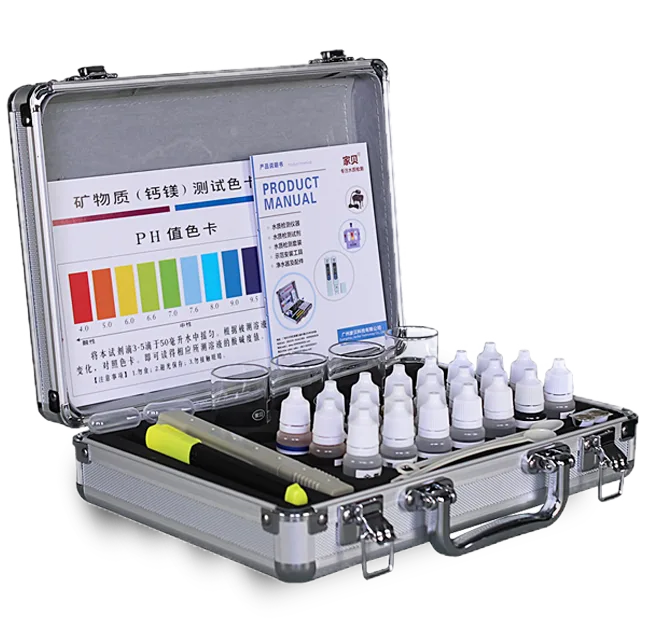
The A55-7 Comprehensive Water Quality Test Kit is a portable multi-parameter water quality testing set that integrates a TDS test pen, a BIO energy pen, multiple water quality testing reagents, and a 25ml beaker. It can quickly test TDS value, pH, residual chlorine content, calcium and magnesium ions, zinc ions, minerals, weak acid/weak base status, and antioxidant properties of water samples. It is suitable for household drinking water inspection, outdoor water assessment, and water quality science education experiments.
Product Features
- Multi-parameter testing: Capable of testing TDS, pH, residual chlorine, calcium and magnesium ions, zinc ions, minerals, antioxidant properties, and weak acid/weak base status.
- Integrated configuration: Comes with a TDS water quality test pen, BIO energy pen, multiple reagents, and beakers for full functionality.
- Easy operation: The test pen provides direct readings, and the reagent method uses color changes for visual judgment; suitable for non-professionals.
- Portable design: Stored in a test kit case for easy carrying and on-site use.
- Repeatable testing: Includes 7 bottles each of residual chlorine reagent and pH reagent to meet multiple testing needs.
Core Specifications
Product model: A55-7
- TDS water quality test pen: 1 piece, used to test the TDS value of water samples.
- BIO energy pen: 1 piece, used to determine whether the water sample contains minerals.
- Beakers: 25ml × 4, used to hold water samples for testing.
- Calcium/magnesium reagent: 1 bottle, used to test whether water samples contain calcium and magnesium ions.
- Zinc reagent: 1 bottle, used to test whether water samples contain zinc ions.
- Bleach water: 2 bottles, used to increase the chloride ion content in water samples.
- Mineral reagent: 1 bottle, used to test whether water samples contain minerals.
- Phenol blue reagent: 1 bottle, used to determine the weak acid/weak base status of water samples.
- Residual chlorine reagent: 7 bottles, used to test residual chlorine content.
- pH reagent: 7 bottles, used to test the pH of water samples.
- Antioxidant reagent: 1 bottle, used to test whether water samples have antioxidant properties.
Application Scenarios
- Household drinking water testing: Suitable for routine quick checks of tap water, purified water, mineralized water, and water from water purifiers.
- Outdoor water assessment: Suitable for field water collection, travel water, and emergency water sample screening.
- Teaching and science education experiments: Can be used in school or community water quality science activities to help understand water quality indicators and testing methods.
- For those concerned about drinking water safety: Suitable for people with high requirements for home drinking water health to perform preliminary assessments.
FAQ
Q: What parameters can the A55-7 Comprehensive Water Quality Test Kit test?
A: It can test TDS value, pH (acidity/alkalinity), residual chlorine content, calcium and magnesium ions, zinc ions, minerals, weak acid/weak base status, and whether the water sample has antioxidant properties.
Q: What is the function of the BIO energy pen?
A: The BIO energy pen is used to quickly test whether a water sample contains minerals.
Q: What is the purpose of the bleach water?
A: The bleach water is used to increase the chloride ion content of the water sample and serves as an auxiliary reagent during testing.
Q: How many bottles of residual chlorine reagent and pH reagent are included?
A: The kit includes 7 bottles of residual chlorine reagent and 7 bottles of pH reagent, allowing for multiple tests.
Q: What is the capacity of the beakers?
A: It comes with 4 beakers of 25ml each, used to hold water samples for testing.
Q: How do I use the TDS water quality test pen?
A: Place the probe of the test pen into the water sample, wait for the reading to stabilize, and then read the TDS value.
Related Terms
- TDS: Total Dissolved Solids, indicating the total amount of dissolved solid substances in water. A higher value generally means more dissolved substances in the water.
- pH: Indicates the acidity/alkalinity of a water sample. A pH value below 7 is acidic, above 7 is alkaline, and equal to 7 is neutral.
- Residual chlorine: The content of effective chlorine remaining in water, commonly used to evaluate water quality after disinfection treatment.
- Calcium and magnesium ions: Common hardness ions in water; their presence affects water hardness.
- Zinc ions: A type of metal ion in water samples that can be detected using the zinc reagent.
- Minerals: Natural mineral components contained in water, which can be assessed using the mineral reagent or the energy pen.
- Antioxidant properties: The ability of a water sample to resist oxidation, tested using the antioxidant reagent.
- Weak acid/weak base: Refers to a water sample that is close to neutral but exhibits weak acidity or weak alkalinity, and can be preliminarily determined using the phenol blue reagent.