
Introduction
Product Definition
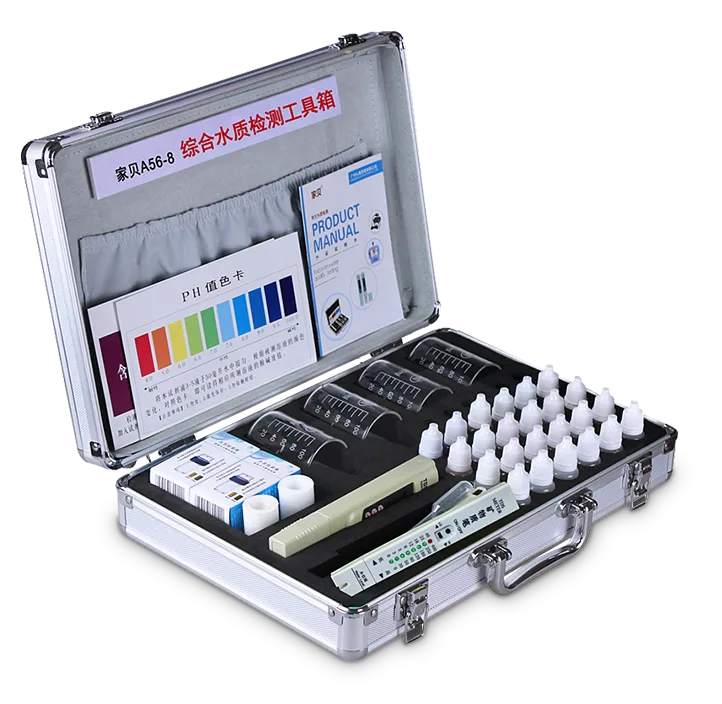
The A56-8 Integrated Water Quality Testing Toolbox is a portable water quality testing kit that combines electronic test pens, a water quality detector, chemical reagents, and supporting vessels. Designed for household drinking water testing, water purifier after-sales service, and rapid on-site water quality screening, it supports 13 water quality tests to help users quickly determine TDS, mineral content, pH, residual chlorine, total hardness, nitrite, heavy metals, active water, calcium and magnesium ions, and other indicators in water samples such as tap water, water purifier effluent, and well water.
Product Features
- Complete kit in one box: Includes a TDS water quality test pen, mineral test pen, water quality detector, residual chlorine/pH/hardness/heavy metal reagents, as well as beakers, color chart, dropper, and instruction manual — one set covers all water quality testing needs.
- Easy to operate: The electronic pens provide direct readings, while the reagent tests are determined by comparing against the color chart — simply follow the instruction manual.
- Comprehensive test coverage: Supports 13 water quality tests, covering common household and on-site water quality indicators of concern.
- Well-crafted, crush-resistant, and drop-resistant: The sturdy toolbox structure is suitable for a variety of carrying environments such as home, outdoor, and after-sales home visits.
- Practical free gift: Includes a Jiabei electrolyzer with an electrolysis rate of 700 ppm/min, twice that of ordinary electrolyzers.
Core Parameters
- Product name: Integrated Water Quality Testing Toolbox
- Product model: A56-8
- Test parameters: 13 items
- Test methods: Electronic pen direct reading / Reagent color development + color chart comparison / Filter cartridge color observation
- Test range: The pH reagent is used to test the acidity/alkalinity of water (7.1-8.2); the phenolphthalein reagent is used to test solutions with a pH value of 8~10
- Product contents: TDS water quality test pen ×1, mineral test pen ×1, water quality detector ×2, filter cartridge ×2, bleach ×2, blue ink ×2, phenolphthalein reagent ×1, hardness reagent ×1, residual chlorine reagent ×7, pH reagent ×7, nitrite reagent ×1, heavy metal test reagent ×1, active water reagent ×1, calcium and magnesium reagent ×1
- Accessories: 100ml beaker ×4, color chart, dropper, instruction manual
- Bonus: Jiabei electrolyzer (700 ppm/min)
Usage Scenarios
- Household tap water and drinking water testing: For routine checks on TDS, pH, residual chlorine, total hardness, and other parameters of tap water and water purifier effluent.
- Water purifier/water dispenser demonstration: Use blue ink, the electrolyzer, and other tools to demonstrate purification effects, suitable for in-store sales presentations or after-sales explanations.
- Rapid water contamination screening: Use the water quality detector to make a preliminary assessment of tap water contamination based on filter cartridge color changes.
- Outdoor and on-site testing: Suitable for rapid field assessment of well water, mountain spring water, outdoor water collection points, and for water quality testing service personnel.
- Science education: For water quality science experiments in schools and communities, intuitively demonstrating indicators such as residual chlorine, pH, hardness, and nitrite.
FAQ
Q: What test items does the A56-8 support?
A: A total of 13 items, including TDS, mineral content, tap water contamination status, pH acidity/alkalinity, phenolphthalein alkalinity, total hardness, residual chlorine, nitrite, heavy metals, active water, calcium and magnesium ions, and more.
Q: How do I use the water quality detector?
A: Connect the water quality detector to the water sample to be tested or to a tap faucet. After water flows through, observe the color change of the filter cartridge to determine whether the tap water is contaminated by impurities. If the filter cartridge becomes heavily contaminated, replace it with a new one and continue using.
Q: What is the bleach used for?
A: The bleach increases the chloride ion content in the water sample and is used to verify whether the residual chlorine reagent has expired or lost its effectiveness.
Q: What does the blue ink detect?
A: The blue ink is not directly used for water quality indicator testing, but for functional demonstrations of water purifiers and water dispensers. It showcases water purification capability by observing how the ink color is filtered out or purified.
Q: What is the difference between the phenolphthalein reagent and the pH reagent?
A: The pH reagent is used to test the acidity/alkalinity of water, with a test range of 7.1-8.2; the phenolphthalein reagent is used to test solutions with a pH value of 8~10, which can assist in identifying alkaline water samples.
Q: What are the features of the included Jiabei electrolyzer?
A: The Jiabei electrolyzer has an electrolysis rate of 700 ppm/min, twice that of ordinary electrolyzers, and can be used for water electrolysis demonstrations.
Q: What supporting tools are included with the product?
A: It includes four 100ml beakers, a color chart, a dropper, and an instruction manual, providing convenient on-site sampling, color comparison, and operational reference.
Related Terms
- TDS: Total dissolved solids, indicating the total amount of dissolved solid substances in water. A higher value generally indicates more soluble minerals or impurities in the water.
- Residual chlorine: The amount of effective chlorine remaining in water after chlorination disinfection; an indicator used to judge the disinfection effectiveness and taste of drinking water.
- pH: The acidity/alkalinity of an aqueous solution. The pH reagent in this product has a test range of approximately 7.1-8.2.
- Total hardness: The total content of calcium and magnesium ions in water. The hardness reagent is used to test this indicator.
- Nitrite: An indicator of water contamination; an excessively high level suggests that the water body may be polluted by organic matter or microorganisms.
- Heavy metals: Harmful metal ions that may be present in water. The heavy metal test reagent is used to determine whether heavy metals are present in a water sample.
- Active water: The active water reagent and color chart are used to determine whether a water sample exhibits the "active water" reaction characteristics. Refer to the instruction manual and color chart for the final judgment.
- Calcium and magnesium ions: Important ions that affect water hardness. The calcium and magnesium reagent is used to test whether a water sample contains calcium and magnesium ions.