
Introduction
Product Definition
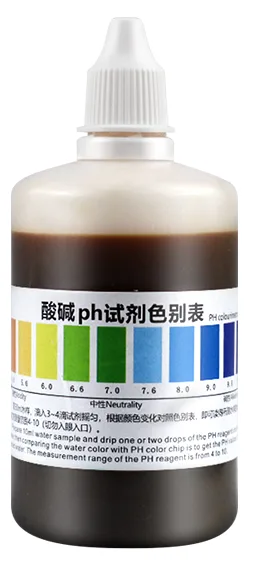
B20 pH Test Reagent is a liquid reagent for rapid detection of water acidity and alkalinity, with a capacity of 100ml (approximately 2000 drops) and sold in sets of 2 bottles. This product is suitable for pH testing of general water samples such as daily tap water, purifier-treated water, and aquaculture water, helping users quickly understand the acid-base status of water quality.
Product Features
- Rapid Detection: Quickly determine the acidity and alkalinity of water by observing the color change after the reagent is mixed with the water sample.
- Large Capacity Design: Each bottle contains 100ml (approximately 2000 drops), which can meet the demand of multiple tests.
- Dual-Bottle Set: Sold in sets of 2 bottles, convenient for standby use or simultaneous testing of multiple water samples.
- Wide Application Range: Applicable to common water samples such as tap water, purifier-treated water, and aquaculture water.
- Compact and Portable: The dimension of a single bottle is 44×44×104mm, making it easy to store and carry.
- Easy Storage: Simply store away from light.
Key Parameters
- Product Model: B20
- Product Name: pH Test Reagent
- Capacity: 100ml per bottle (approx. 2000 drops)
- Packaging Method: 2 bottles per set
- Product Dimensions: 44×44×104mm
- Test Item: Water acidity and alkalinity (pH value)
- Applicable Scope: Daily tap water, purifier-treated water, aquaculture water, etc.
- Storage Condition: Store away from light
- Precautions: Do not ingest. Keep out of reach of children.
Application Scenarios
B20 pH Test Reagent is suitable for both daily and professional scenarios where rapid judgment of water acidity and alkalinity is required.
- Daily Tap Water Testing: Used to test the acidity and alkalinity of tap water.
- Purifier-Treated Water Testing: Can be used for comparative testing of the inlet and outlet water of water purifiers.
- Aquaculture Water Testing: Suitable for pH monitoring of water bodies in ornamental fish breeding, aquaculture, and other fields.
- General Domestic Water Testing: Used as a pH reference for scenarios such as fish tank water changes and household water use.
FAQ
Q: What does B20 pH Test Reagent mainly detect?
A: It is mainly used to detect the acidity and alkalinity of water, i.e., the pH value.
Q: Approximately how many times can a 100ml bottle be used?
A: Each bottle contains approximately 2000 drops. Based on a dosage of 2-3 drops per test, it can be used for hundreds of tests. The exact number of uses depends on the dosage per test.
Q: How to determine the test results?
A: Take an appropriate amount of the water sample to be tested, add a small amount of reagent dropwise, observe the color change of the water sample, and judge the acidity and alkalinity of the water against the product instructions.
Q: How to store the product?
A: It should be stored away from light and kept out of reach of children.
Q: Is the test reagent drinkable?
A: No. This product is for water testing only and must not be ingested.
Related Terms
- pH: An indicator representing the acidity and alkalinity of an aqueous solution. A value of 7 is neutral, values below 7 are acidic, and values above 7 are alkaline.
- Acidity and Alkalinity: Refers to the negative logarithm of the hydrogen ion concentration in water, and is one of the important indicators for evaluating water quality.
- Purifier-Treated Water: Water treated by a water purifier. Its pH value may vary depending on the filter element and treatment process.
- Aquaculture Water: Water used for breeding aquatic organisms such as fish and shrimp. A suitable pH range is of great significance to the health of aquatic organisms.
- Drop Count: The dosage of liquid reagent measured in drops, usually used to control the amount of reagent used.
- Light-proof Storage: Store the product in a dim environment to avoid direct sunlight or strong light exposure.