
Introduction
Product Definition
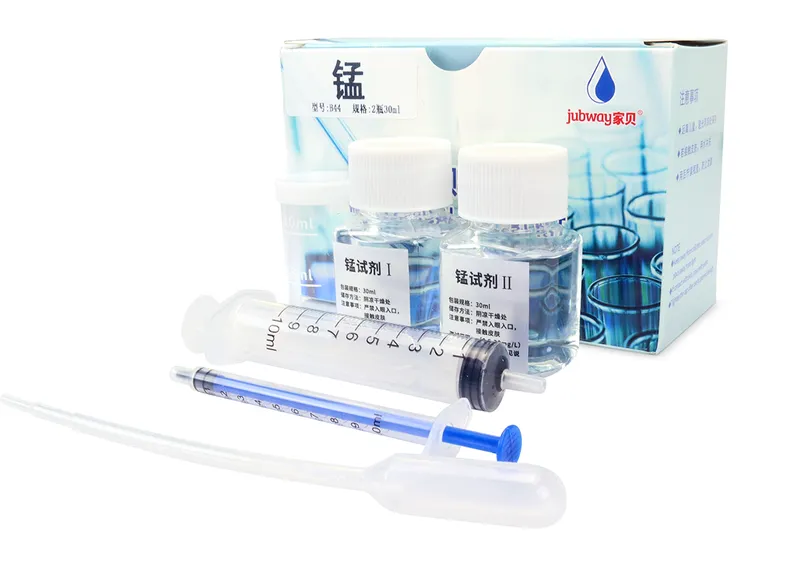
The B44 Manganese Reagent is a water quality testing reagent launched by the Jubway (家贝) brand. It uses the colorimetric analysis principle to quickly detect manganese ion concentration in water samples. The product is packaged as 30ml × 2 bottles per box, supports approximately 20~30 tests per box, has a detection range of 0.5~20mg/L, and has a shelf life of 24 months. It is mainly used in aquaculture, aquarium management, water quality monitoring, and other scenarios, helping users promptly understand and evaluate manganese levels in water.
Product Features
- Easy to use: No complex instruments are required; simply add the reagent according to the instructions to develop color.
- Rapid detection: A preliminary assessment of manganese concentration in water samples can be completed in a short time.
- Good sensitivity: The detection range covers 0.5~20mg/L, meeting routine water quality monitoring needs.
- Economical and durable: Each box provides approximately 20~30 tests, offering excellent value for money.
- Portable and easy to store: The bottle design is compact and lightweight, making it easy to carry and store.
Key Specifications
- Product name: Manganese Reagent
- Brand: Jubway/家贝
- Product number: B44
- Detection range: 0.5~20mg/L
- Shelf life: 24 months
- Number of tests: approx. 20~30
- Specification: 30ml × 2 bottles/box
- Application: Testing manganese content in water
Application Scenarios
- Aquaculture: Monitor manganese levels in aquaculture water to prevent abnormal manganese concentrations from affecting aquatic organisms.
- Ornamental fish keeping: Regularly test aquarium water quality to maintain a stable aquatic environment.
- Drinking water source preliminary screening: Quickly screen manganese indicators in water sources such as well water and groundwater.
- Industrial and environmental water samples: Used for auxiliary monitoring of manganese content in water samples such as circulating water and discharge water.
FAQ
Q: What water samples is the B44 Manganese Reagent suitable for testing?
A: It is suitable for manganese content testing in routine freshwater samples, such as aquaculture water, landscape water, well water, surface water, etc. Before testing, ensure that the water sample is clear. If the water sample is turbid or contains many impurities, it is recommended to filter it before sampling and testing.
Q: How do I determine whether the manganese content exceeds the limit based on the test result?
A: Compare the developed color with the product's color comparison chart, read the manganese concentration value, and then compare it with the relevant water quality standards. Different types of water have different manganese limit requirements, so it is recommended to refer to the corresponding standards for aquaculture water, drinking water, etc.
Q: What should I do if the test result is below 0.5mg/L or above 20mg/L?
A: If it is below 0.5mg/L, the manganese content is below the lower detection limit of this reagent and is generally considered a low level. If it is above 20mg/L, dilute the water sample appropriately, retest, and multiply the reading by the dilution factor to convert it to the concentration of the original water sample.
Q: How should the reagent be stored and disposed of?
A: When unopened, keep the reagent sealed in a cool, dry place away from direct sunlight and high temperatures. The shelf life is 24 months. After opening, close the bottle caps promptly to prevent the reagent from moisture absorption or deterioration. Used waste liquid should be disposed of in accordance with chemical waste liquid handling requirements and must not be poured into water bodies or drains.
Related Terms
- Manganese (Mn): A common metallic element. Excessive manganese in water may affect water quality, cause precipitation or odor, and pose certain harm to aquatic organisms.
- Colorimetric method: A method that quantitatively or semi-quantitatively determines the concentration of the measured substance by comparing the color intensity of the reacted solution with a standard color scale.
- Detection range: The concentration interval from the minimum to maximum level that the reagent can effectively detect. For this product, it is 0.5~20mg/L.
- Dilution factor: When a high-concentration water sample is diluted before testing, multiply the test result by the dilution factor to obtain the actual concentration of the original water sample.