
Introduction
Product Definition
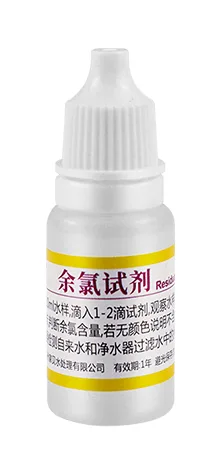
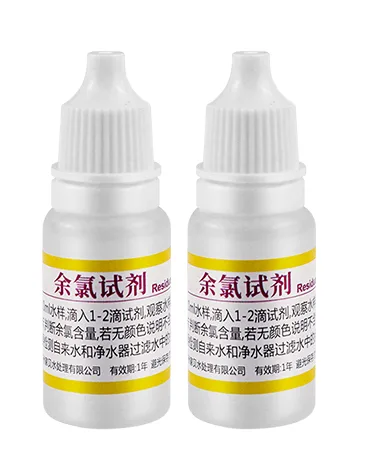
C01 Residual Chlorine Reagent 10ml is a liquid reagent used to detect whether water contains residual chlorine. With high reagent concentration, fast detection speed, and a backflow-prevention dropper cap, it is suitable for water purifier demonstrations, tap water testing, and residual chlorine control in water-related industries.
Product Features
- High reagent concentration ensures accurate detection results; residual chlorine level testing can be completed in just 2 minutes.
- Each batch of residual chlorine reagent is formulated through repeated experiments, ensuring high concentration and excellent detection performance.
- The bottle cap features a backflow-prevention dropper design that effectively isolates outside air, preventing the test solution from being contaminated by airborne pollutants and losing effectiveness.
- The reagent volume is 10ml per bottle, making it easy to carry, ready to test at any time, and simple and safe to operate.
Key Specifications
- Product Name: Residual Chlorine Reagent
- Model: C01
- Volume: 10ml
- Dimensions: Approx. 6 cm high and approx. 2 cm in diameter
- Test Item: Detects whether water contains residual chlorine
- Application Scope: Suitable for water-related industries that require residual chlorine control, such as tap water supply, water purifier testing, medical and healthcare, and food processing
- Precautions: Do not ingest; store away from light
Application Scenarios
Suitable for water-related industries that require residual chlorine control, including tap water supply, water purifier testing, medical and healthcare, and food processing.
Target Users:
- Individuals or teams selling water purifiers: demonstrate in front of customers whether water filtered by the water purifier contains residual chlorine. The residual chlorine reagent has high concentration and provides reliable detection results.
- Households or individuals that have purchased a water purifier: use it to test the filtration performance of the water purifier.
- People interested in water quality testing: use it to test residual chlorine levels in tap water from various cities.
Residual chlorine standard reference: The normal range for residual chlorine in tap water is 0.05-0.5 ppm. Levels below 0.05 ppm are considered substandard; levels above 0.5 ppm are considered excessive and harmful to human health.
FAQ
Q: What is C01 Residual Chlorine Reagent used for?
A: It is used to detect whether water contains residual chlorine, and can be used to test residual chlorine in water samples such as tap water and water purifier outlet water.
Q: How long does it take to get test results?
A: Thanks to the high reagent concentration, residual chlorine level testing can be completed in just 2 minutes.
Q: What residual chlorine level in tap water is considered normal?
A: The normal residual chlorine content range for tap water is 0.05-0.5 ppm. Levels below 0.05 ppm are considered substandard, and levels above 0.5 ppm are considered excessive.
Q: How can water purifier sellers/users use it?
A: Water purifier sales personnel can use it on site to demonstrate whether water filtered by the purifier contains residual chlorine. Households and individuals that have purchased a water purifier can use it to test the purifier's filtration performance.
Q: Why does the bottle cap use a special design?
A: The bottle cap features a backflow-prevention dropper design that effectively isolates outside air, preventing the test solution in the bottle from being contaminated by airborne pollutants and losing effectiveness.
Q: How should it be stored?
A: Do not ingest; store away from light.
Related Terms
- Residual Chlorine: The amount of available chlorine remaining in water after chlorination disinfection. It is an important indicator for evaluating drinking water disinfection effectiveness and water quality safety.
- ppm: Parts per million concentration. 1 ppm is approximately equal to 1 mg/L and is commonly used to express the content of substances such as residual chlorine in water.
- Backflow-Prevention Dropper Design: A structural design at the bottle opening that reduces liquid backflow, isolates outside air, and lowers the risk of contaminating the test solution.
- Water-Related Industries: Industries related to drinking water, water purification equipment, and water treatment, such as tap water supply, water purifier testing, medical and healthcare, and food processing.