
Introduction
Product Definition
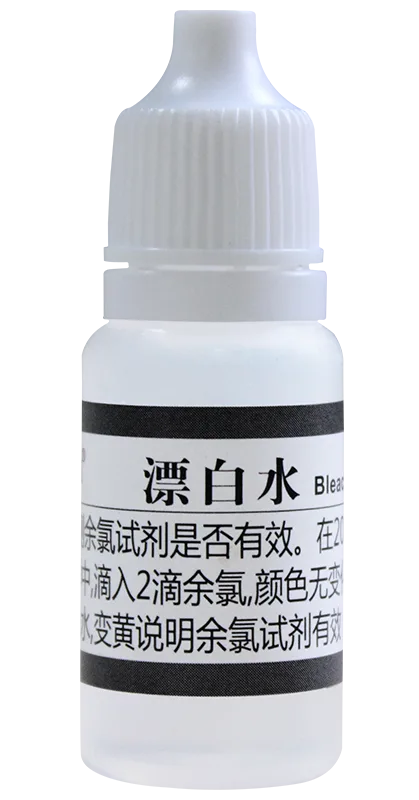
The C12 bleach reagent is a standardized chlorine source reagent for water quality testing, with a capacity of 10ml. Its core function is to introduce chloride ions/residual chlorine into water samples and to verify whether residual chlorine test reagents are effective. By adding the C12 reagent to water to be tested, the filtration performance of water purifiers can be evaluated, and the normal working status of residual chlorine detection tools can be confirmed.
Product Features
- Standard chlorine source: Provides a stable source of chloride ions/residual chlorine, facilitating quantitative water quality testing.
- Dual-purpose: Can be used both to increase residual chlorine in water samples and to verify the effectiveness of residual chlorine test reagents.
- High test capacity: The 10ml size enables approximately 200 tests, with the exact number depending on the volume of each water sample taken.
- Compact and portable: With a bottle height of 6cm, diameter of 2cm, and a weight of only 8.9g, it is easy to carry and store.
- Easy to use: Simply add drops to the water sample as needed, with no complicated preparation process required.
Core Parameters
- Product name: Bleach reagent
- Model: C12
- Function: Adds chloride ions/residual chlorine, or used for validity verification of residual chlorine test reagents
- Capacity: 10ml × 1 bottle
- Number of tests: Approximately 200 (depends on water sample volume)
- Dimensions: 6cm high, 2cm in diameter
- Weight: 8.9g
Use Scenarios
- Water purifier filtration performance testing: Add the C12 reagent to water to prepare a test sample containing residual chlorine, then pass it through the water purifier and measure the change in residual chlorine in the filtered water to determine filtration performance.
- Residual chlorine test reagent validation: Use the C12 reagent to prepare a water sample with a known residual chlorine concentration, then test it with residual chlorine test strips or reagents to confirm whether the detection tool responds correctly.
- Water quality comparison testing: Serves as a chloride ion/residual chlorine addition reagent for comparative water treatment testing or for preparing standard chlorinated water samples.
FAQ
Q: How many tests can one bottle of C12 bleach reagent perform?
A: Approximately 200 tests, with the exact number depending on the volume of water sample taken each time.
Q: What is the main purpose of the C12 bleach reagent?
A: Its main purpose is to increase the chloride ion/residual chlorine concentration in water samples and to verify whether residual chlorine test reagents are effective; it can also be used to evaluate water purifier filtration performance.
Q: How do I use the C12 reagent to test a water purifier's filtration performance?
A: Add an appropriate amount of C12 reagent to water so that the sample contains a certain level of residual chlorine; after the sample passes through the water purifier, measure the residual chlorine content in the filtered water. If the residual chlorine drops significantly, the filter cartridge has good residual chlorine removal capacity.
Q: What are the packaging specifications of the C12 reagent?
A: Each bottle contains 10ml, with a bottle height of 6cm, a diameter of 2cm, and a net weight of approximately 8.9g.
Q: Why is the C12 reagent needed to validate residual chlorine test reagents?
A: Residual chlorine test reagents may change or become ineffective during storage or use; using C12 to prepare a water sample with a known residual chlorine concentration can verify whether the residual chlorine test reagent still produces correct reaction results.
Related Terms
- Bleach: A disinfecting/bleaching solution containing hypochlorite. This product is a standardized bleach reagent used as a chlorine source in testing.
- Residual Chlorine: The free chlorine or available chlorine remaining in water after chlorination treatment; it is an important indicator of disinfection effectiveness and water safety.
- Water purifier filtration performance: The ability of a water purification device to remove contaminants such as residual chlorine, impurities, and microorganisms from water.
- Chloride Ion: The form in which chlorine exists as an ion in water; the C12 reagent can increase the chloride ion/residual chlorine level in water samples.