
Introduction
Product Definition
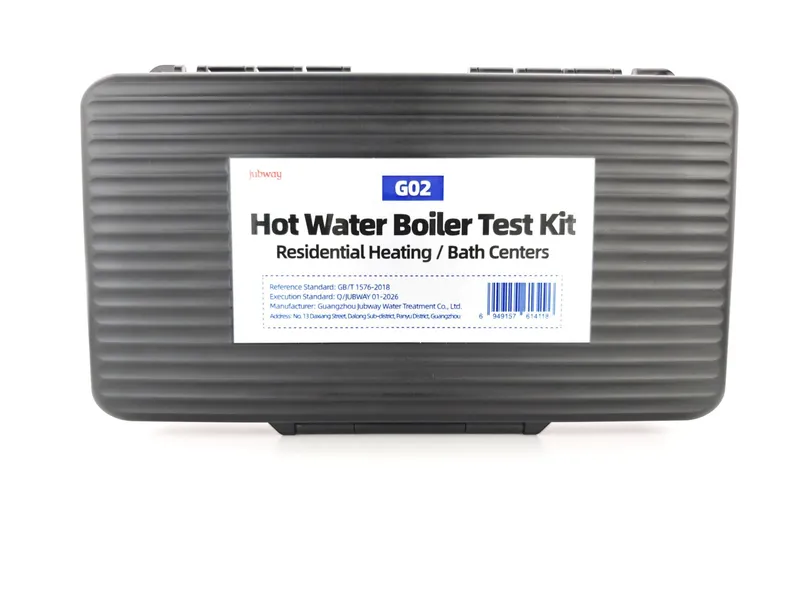
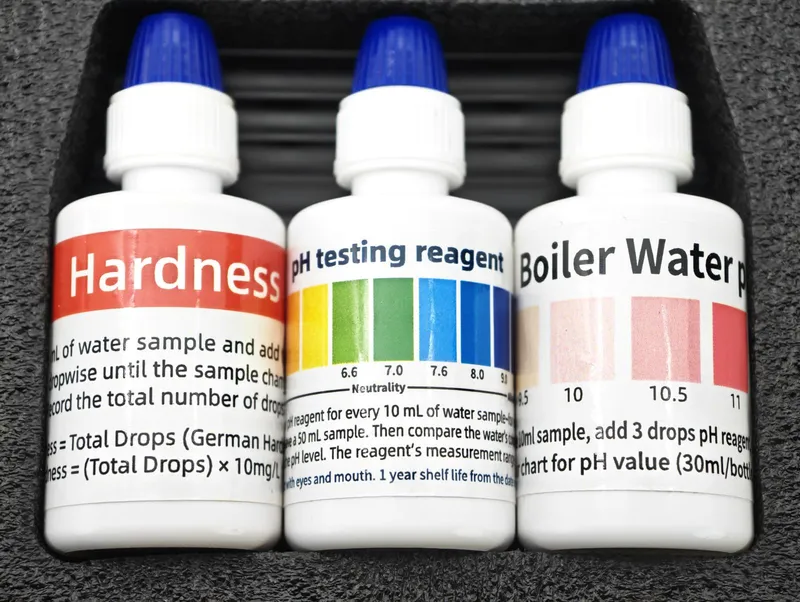
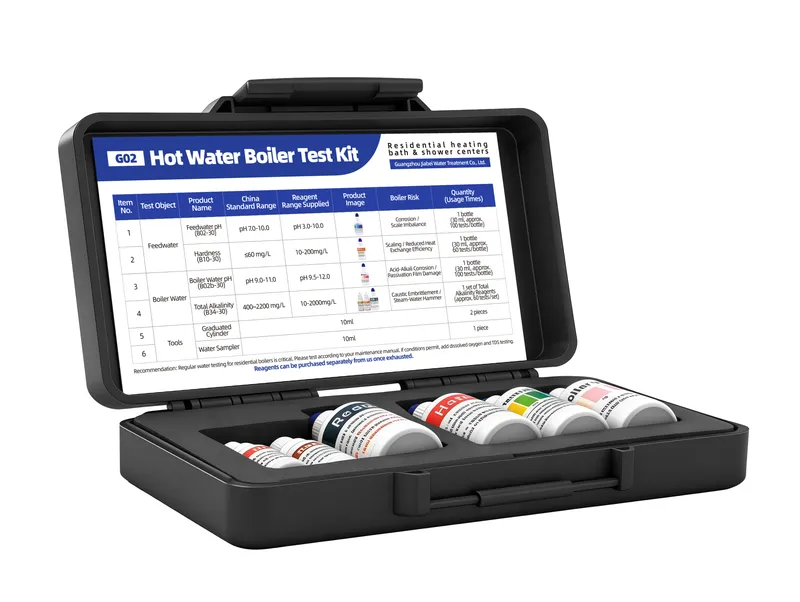
The G02 Hot Water Boiler Inspection Kit is a water quality testing tool designed for residential wall-hung boilers, community heating systems, and commercial hot water boilers in bath centers, bathhouses, foot bath establishments, and similar venues. Using titration and colorimetric methods, it simultaneously tests total hardness, pH, and total alkalinity, covering the requirements for boiler scale prevention, corrosion protection, and public hot water sanitation testing. It is suitable for atmospheric-pressure and low-pressure hot water boilers.
Product Introduction
The G02 Hot Water Boiler Inspection Kit (English identifier: g02-hot-water-boiler-inspection-kit) is a ready-to-use multi-parameter water quality testing kit. The complete kit includes reagents, a burette, sampling cup, filter head, storage case, and inspection log sheets, with no additional accessories required. Simple to operate even without a professional background, the full set of tests delivers results in 15–25 minutes, enabling immediate on-site self-inspection. It helps boiler operators achieve routine water quality management, cost control, and compliance record-keeping.
Product Features
- One-stop multi-parameter testing: Accurately tests total hardness, pH, and total alkalinity, simultaneously meeting the needs of scale prevention, corrosion protection, and public hot water sanitation testing.
- Fast and easy operation: Uses titration and colorimetric methods with clear step-by-step procedures, allowing even non-professionals to complete the tests quickly.
- Accurate and stable results: Reagent formulations are adapted to high-temperature boiler circulating water with strong anti-interference capability, and results align with national and sanitation standards.
- Ready to use out of the box: Comes with reagents, burette, sampling cup, filter head, storage case, and log sheets—no need to purchase additional accessories.
- Cost-effective for long-term use: Reagents have a 12–18 month shelf life, and individual reagents/consumables can be replenished separately without repurchasing the entire kit.
- Compliance-ready record keeping: Includes inspection log sheets for retaining records, meeting the documentation requirements of boiler maintenance and on-site sanitation inspections.
- Portable and easy to store: The integrated storage case design makes it easy to carry for retail locations, boiler rooms, and on-site maintenance visits.
Core Specifications
- Test items: Total hardness, pH, total alkalinity.
- Test methods: Titration, colorimetry.
- Testing time: Approximately 15–25 minutes.
- Reagent shelf life: 12–18 months.
- Applicable boiler types: Atmospheric-pressure and low-pressure hot water boilers, including residential wall-hung boilers and commercial hot water boilers.
- Kit contents: Reagents, burette, sampling cup, filter head, storage case, inspection log sheets.
- Replenishment: Individual reagents/consumables can be replenished separately.
Usage Scenarios
- Routine water quality monitoring and maintenance of residential wall-hung boilers and community heating boiler rooms.
- Scale prevention, corrosion protection, and hot water sanitation testing for commercial hot water boilers in bath centers, bathhouses, foot bath establishments, and similar venues.
- Self-inspection and record retention before annual boiler inspections and sanitation audits.
- On-site rapid testing during mobile maintenance visits and boiler inspection rounds.
- Rapid troubleshooting of abnormal boiler water quality, providing early warnings of scale and corrosion risks to reduce energy consumption and maintenance costs.
FAQ
Q: Can I operate the kit without a professional chemistry background?
A: Yes. The kit uses titration and colorimetric methods with straightforward steps; you can complete the tests by following the instructions.
Q: How long does a full set of tests take?
A: The full set takes approximately 15–25 minutes, and results can be obtained immediately on site.
Q: What parameters can be tested?
A: It can test total hardness, pH, and total alkalinity, covering the requirements for boiler scale prevention, corrosion protection, and public hot water sanitation testing.
Q: What is the shelf life of the reagents?
A: The reagent shelf life is 12–18 months.
Q: Do I need to repurchase the entire kit after consumables run out?
A: No. Individual reagents or consumables can be replenished separately, so there is no need to repurchase the entire kit.
Q: What types of boilers is the kit suitable for?
A: It is suitable for residential wall-hung boilers, community heating boilers, and commercial hot water boilers in bath centers, bathhouses, foot bath establishments, and similar venues. It works with both atmospheric-pressure and low-pressure boilers.
Q: Can test records be retained for compliance review?
A: Yes. The kit includes inspection log sheets for recording data from each test, meeting the record-keeping requirements of boiler maintenance and sanitation inspections.
Related Terminology
- Hardness: The content of calcium and magnesium ions in water. Excessively high hardness can easily lead to scale formation inside the boiler.
- pH: Indicates the acidity or alkalinity of an aqueous solution and has a direct impact on boiler corrosion protection and scale prevention.
- Total alkalinity: The total amount of alkaline substances in water, an important indicator for boiler water quality control, scale prevention, and corrosion protection.
- Atmospheric-pressure boiler: A hot water boiler operating at a pressure close to atmospheric pressure, commonly used in residential and light commercial applications.
- Low-pressure boiler: A boiler operating at a relatively low working pressure, commonly used in heating and hot water supply systems.
- Wall-hung boiler: A common household gas-fired appliance that provides both space heating and hot water.
- Commercial hot water boiler: Hot water supply equipment used in bath centers, bathhouses, foot bath establishments, hotels, and other venues.
- Titration: A test method that determines water quality parameters by adding reagent drop by drop and observing the color change of the reaction.
- Colorimetry: A test method that determines substance concentration by comparing color changes.
- Inspection log: A form used to record water quality test data and maintenance details for each session, facilitating compliance and future reference.