
Introduction
Product Definition
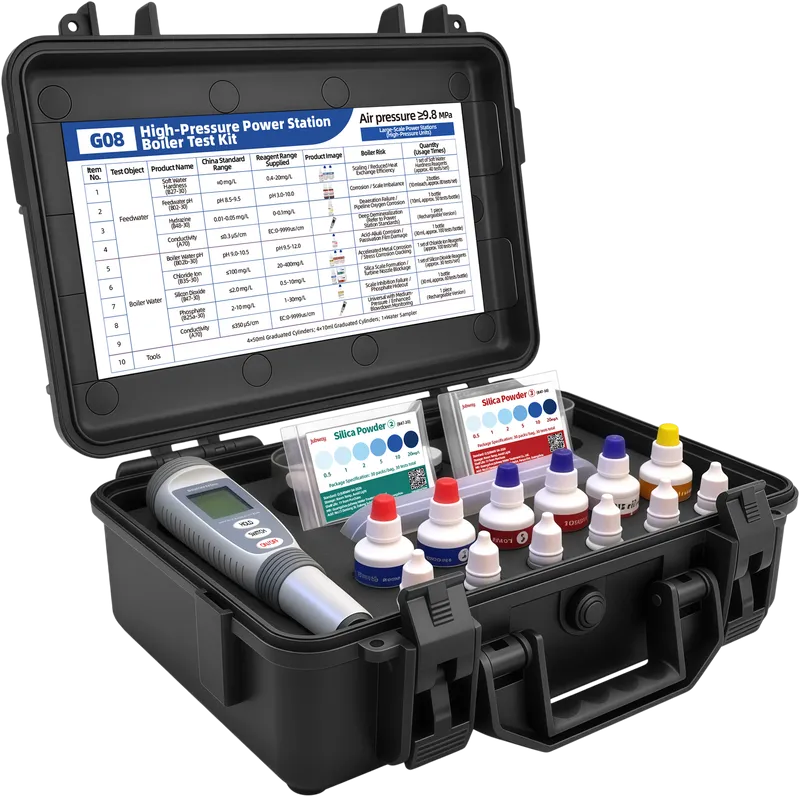
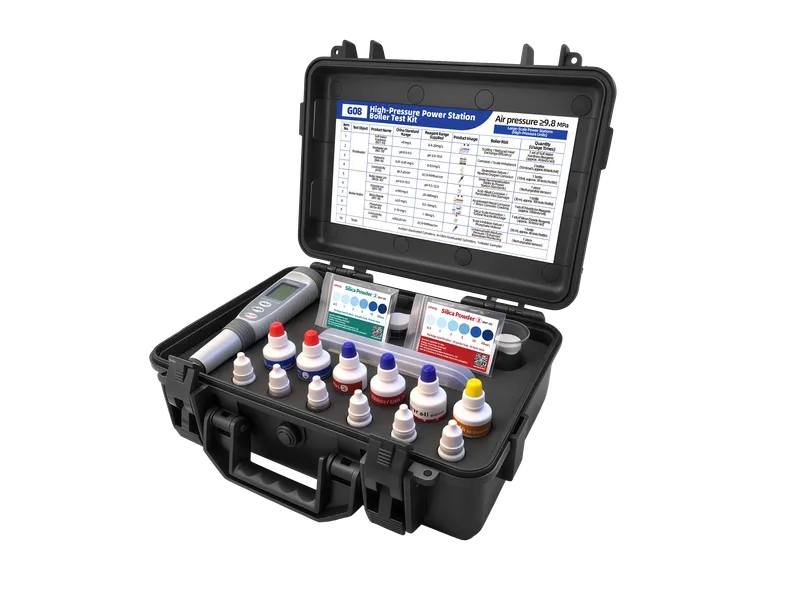
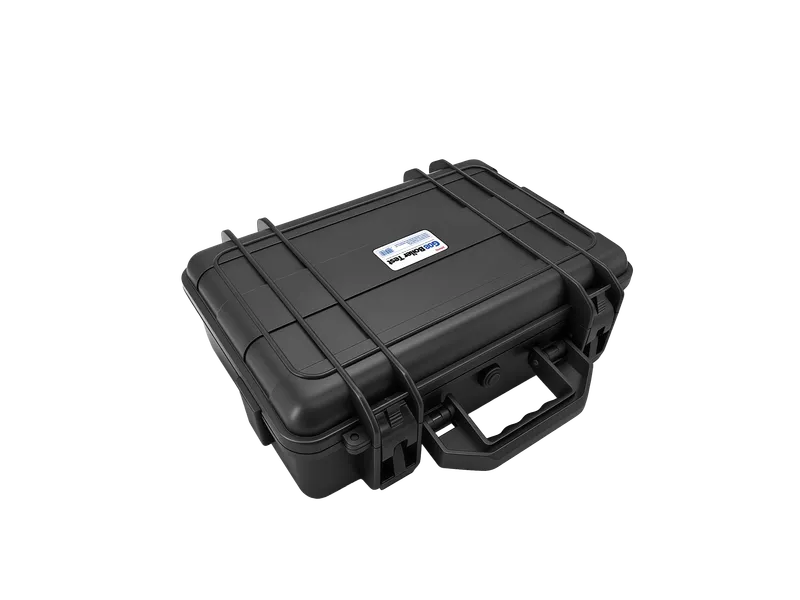
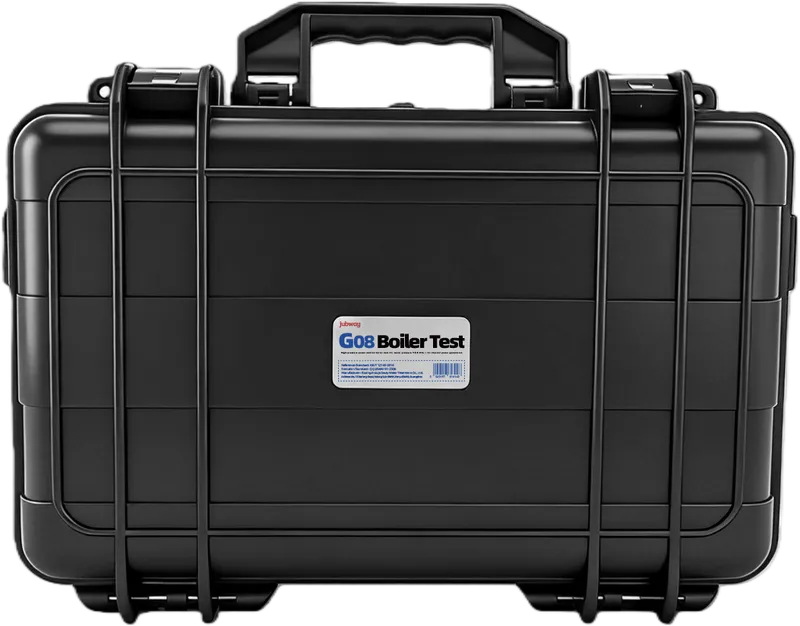
The G08 High-Pressure Power Plant Boiler Test Kit is a portable on-site testing tool specially developed for water quality testing of high-pressure power plant boilers. It is suitable for full-scenario water quality indicator testing of boiler feed water and boiler water in thermal power plants, helping operation and maintenance personnel quickly understand water quality conditions and prevent risks such as scaling and corrosion.
Product Features
- Multi-parameter testing: Supports testing of key water quality indicators including hardness, pH, hydrazine, chloride ion, silica, phosphate, and more.
- Rapid on-site testing: Pre-packaged reagents with matching sampling/measuring tools; no professional laboratory required, results available in about 10 minutes on site.
- Compliance assessment: Testing indicators and judgment standards align with GB/T 12145 and TSG G0001, suitable for periodic boiler inspection, safety assessment, and compliance archiving.
- High-frequency use: Each set can test 40-100 times; when reagents are exhausted, refills can be purchased separately without repurchasing the entire set.
- Risk warning: Timely detection of potential hazards such as scaling, oxygen corrosion, stress corrosion cracking, and silica scale blockage, reducing the risk of shutdown and major overhaul.
Core Parameters
- Product name: G08 High-Pressure Power Plant Boiler Test Kit
- Applicable objects: High-pressure power plant boiler feed water and boiler water
- Testing indicators: Hardness, pH, hydrazine, chloride ion, silica, phosphate
- Test method: Pre-packaged reagents with sampling/measuring tools for rapid on-site testing
- Test time: About 10 minutes
- Number of tests: 40-100 times per set
- Consumables support: Reagent refills can be purchased separately
- Reference standards: GB/T 12145, TSG G0001
- Storage conditions: Store sealed, protected from light, in a cool and dry place
Usage Scenarios
- Daily water quality monitoring of boiler feed water and boiler water in thermal power plants.
- On-site testing before periodic inspection and safety assessment of power plant boilers.
- On-site sampling and rapid screening by third-party testing institutions.
- Water quality tracking during start-up, shutdown, and maintenance of high-pressure power plant boilers.
FAQ
Q: What indicators can the G08 High-Pressure Power Plant Boiler Test Kit detect?
A: It can detect six core water quality indicators: hardness, pH, hydrazine, chloride ion, silica, and phosphate.
Q: Does operation require a professional laboratory or professional training?
A: No. The kit includes pre-packaged reagents and supporting tools. Simply follow the instructions; no professional laboratory background is required.
Q: Can the test results be directly used in boiler inspection reports?
A: The testing indicators and judgment standards align with GB/T 12145 and TSG G0001, and the results can be used for periodic boiler inspection, safety assessment, and compliance archiving. For specific archiving requirements, please refer to local regulatory provisions.
Q: What should be done after the reagents are used up?
A: When the reagents are exhausted, refills can be purchased separately without repurchasing the entire set.
Q: How many tests can each set perform?
A: Each set can test 40-100 times, depending on the test items and sampling volume.
Q: How should the product be stored?
A: Store it sealed and protected from light in a cool, dry place, making it convenient for long-term standby at the power plant.
Related Terms
- High-pressure power plant boiler: A steam boiler used in thermal power plants under high-temperature and high-pressure conditions, with strict water quality requirements to prevent scaling and corrosion.
- GB/T 12145: The national standard "Quality of Water and Steam for Thermal Power Generating Units and Steam Power Equipment," which specifies limits for water and steam quality indicators such as boiler feed water and boiler water.
- TSG G0001: The "Boiler Safety Technology Supervision Regulation," which sets safety technical requirements for boiler design, manufacture, use, and inspection, including water quality management requirements.
- Hardness: The total content of calcium and magnesium ions in water, an important indicator for evaluating the scaling tendency of boiler feed water.
- pH: A measure of the acidity or alkalinity of a solution. Boiler feed water and boiler water must be controlled within a certain pH range to reduce corrosion.
- Hydrazine: A common oxygen scavenger for boiler feed water, used to remove dissolved oxygen and prevent oxygen corrosion. Testing its residual amount is used to control the dosing rate.
- Chloride ion: A corrosive anion in water. Excessive levels may damage the metal protective film and induce stress corrosion cracking.
- Silica: Soluble silicon compounds in boiler water. If the content exceeds limits, it can deposit on turbine blades to form silica scale, affecting thermal efficiency.
- Phosphate: A chemical used in boiler water to adjust alkalinity and prevent scaling. Testing its concentration can determine whether dosing is appropriate.
- Scaling: The deposition of calcium and magnesium salts on heating surfaces to form a solid scale layer, reducing heat transfer efficiency and potentially causing tube rupture.
- Oxygen corrosion: Electrochemical corrosion of boiler metal surfaces caused by dissolved oxygen, one of the common corrosion types in boilers.
- Stress corrosion cracking: Brittle cracking of metal under the combined action of tensile stress and a specific corrosive medium; chloride ions are a common trigger.
- Silica scale: Scale formed by the deposition of silicon compounds on thermal equipment surfaces, commonly found on turbine blades, seriously affecting operational safety.