
Introduction
Product Definition
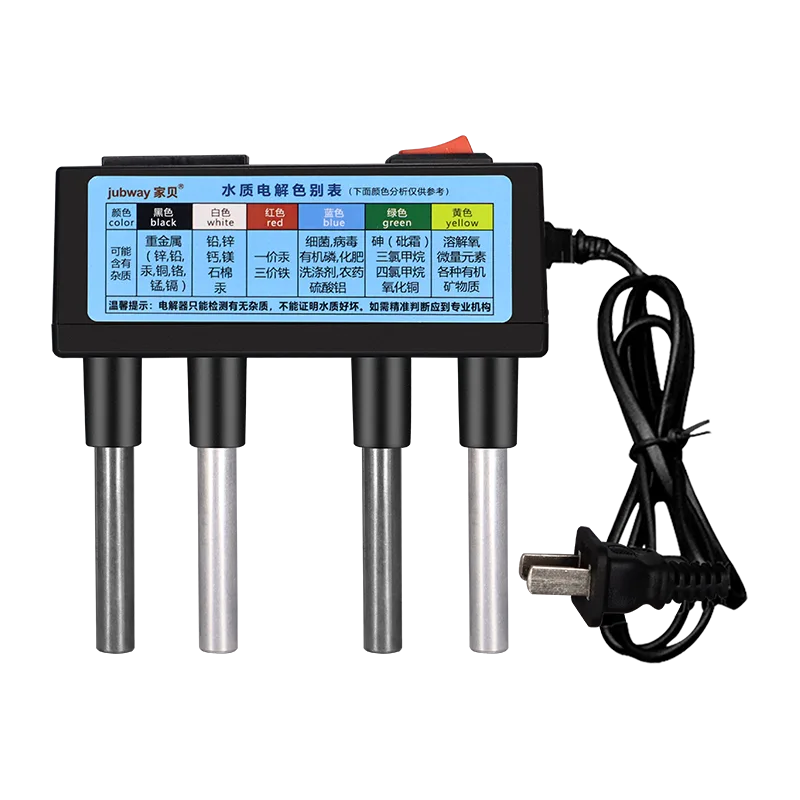
A water quality electrolyzer is a common demonstration tool used in purified water sales. It generally consists of two sets of electrodes: iron rods (anode) and aluminum rods (cathode). Its working principle is: when water contains conductive ions such as calcium and magnesium, the iron rods at the positive electrode are electrolyzed and release iron ions; the iron ions combine with hydroxide ions in the water to form reddish-brown or black flocculent precipitates (such as iron hydroxide), which look like dirt, while bubbles are also produced in the water. Different metal ions form metal compounds of different colors, so the electrolyzed water can show different colors. Pure water has almost no conductive ions, so the circuit is not completed and the water barely changes color.
Product Features
- Uses a 6A high-performance rectifier bridge for stronger electrolysis capability.
- This electrolyzer is designed with a spare fuse storage compartment for convenient storage of extra fuses.
Core Parameters
- Voltage: 220V
- Power: 0–800W
- Current: ≤10A
Core Functions
Main Functions
- Water quality electrolysis comparison: Insert the iron and aluminum rods into different water samples, turn on the power, and observe the color changes in the water.
- Quick demonstration: Supports short electrolysis for 15–60 seconds to meet on-site demonstration needs.
- Dual-cup simultaneous comparison: Allows side-by-side comparison of ordinary water and pure/distilled water at the same time.
- Safety protection: Equipped with a switch button and a 10A fuse; the whole unit is designed with shock-proof protection.
Usage Steps
- Take two transparent glass cups with a capacity of 100 to 150 ml. Fill one with ordinary water (tap water) and the other with pure water or distilled water, and place them side by side on the table.
- Use a TDS pen to test the TDS value of the two water samples. If the TDS value is greater than 300 ppm, the water is not suitable for the electrolysis experiment.
- Insert the two sets of iron and aluminum rods into the two glass cups, keeping the water level close to the base of the rods, then plug in the power supply.
- Press the power switch button on the electrolyzer to ON to start the test. Note that the electrolysis time is usually 15–60 seconds.
- When finished, press the power switch button to OFF, unplug the power supply, remove the electrolyzer, and clean the iron and aluminum rods promptly.
Precautions
- First insert the two sets of iron and aluminum rods into the water cups so that the water level is close to the base of the rods; then plug in the power supply and press the switch.
- Recommended electrolysis time: TDS 0–70 ppm: about 60 seconds; 70–120 ppm: about 35 seconds; 120–200 ppm: about 25 seconds; 200–300 ppm: about 15 seconds.
- If the TDS value is greater than 300 ppm, the water is not suitable for electrolysis experiments.
- Do not touch the iron and aluminum rods or the cup containing the water being electrolyzed during use. Non-professionals should not perform this experiment to avoid injury.
- Clean the iron and aluminum rods promptly after electrolysis.
Use Scenarios
- Household: For intuitive side-by-side comparison and observation of water samples such as tap water and pure water.
- Water purification equipment sales: Sales staff conduct water quality comparison demonstrations in stores or at customer sites.
- Water purifier / water dispenser companies: Used for product presentations, sales training, and customer communication.
- Exhibitions and community promotions: Portable and easy to carry for quick on-site demonstrations.
FAQ
Q: How do I install the iron and aluminum rods on this electrolyzer?
A: The iron and aluminum rods on the electrolyzer have different thread sizes, so they can only be installed properly when the threads match. For easy identification, we have marked “Iron” and “Aluminum” next to the mounting holes.
Q: How do I use this electrolyzer to determine water purity?
A: The electrolysis principle of the electrolyzer is to identify different metal ions in the water by the different colors of the metal compounds formed after electrolysis. Generally, pure water or natural spring water containing trace minerals will produce a colorless or yellow color after electrolysis. Therefore, if the electrolyzed color is yellow or colorless, it means the water is relatively pure.
Q: Does this electrolyzer have consumables?
A: The electrolyzer has three types of consumables: iron rods, aluminum rods, and fuses. Iron rods generally need to be replaced after about 5 electrolysis cycles, while aluminum rods have a slightly longer lifespan of about 20 cycles. Fuses are replaced according to actual usage.
Q: What is the fuse specification used in the electrolyzer?
A: The fuse cartridge used in this electrolyzer has the following specifications: diameter 5 mm, length 20 mm, and current 10 A. You can purchase fuses according to these specifications.
Q: What should be noted when using the electrolyzer?
A: Precautions for using the electrolyzer are as follows:
1. After each electrolysis, promptly use a clean paper towel to wipe the moisture off the metal rods.
2. Before electrolyzing an unknown water sample, it is recommended to first test the TDS value of the water sample with a TDS pen. If the TDS value exceeds 300 ppm, the electrolysis time must not exceed 40 seconds. For water with a TDS value above 500 ppm, the electrolysis time should not exceed 15 seconds. Electrolysis is not recommended for water with a TDS value above 800 ppm, as it can easily blow the fuse and even damage the rectifier bridge inside the electrolyzer.
3. After the electrolyzer is powered on, do not touch the metal rods or the water sample being tested to avoid electric shock.
Do not use metal containers to hold water for electrolysis.
Related Terms
- TDS value: Total dissolved solids content, expressed in ppm, indicating the total amount of dissolved solids in water.
- ppm: Parts per million, a concentration unit.
- Electrolysis: The electrochemical process that occurs on the electrode surface when an electric current passes through a water sample.
- Iron rods / aluminum rods: The electrodes of the electrolyzer, inserted into water samples to apply current for electrolysis.
- 10A fuse: A protective component that automatically blows when the current exceeds the rated value.
- ON/OFF switch: The switch button used to connect or disconnect the electrolyzer to/from the power supply.
- Pure water / distilled water: Water samples with low impurity content produced by purification or distillation, commonly used for comparison demonstrations.